
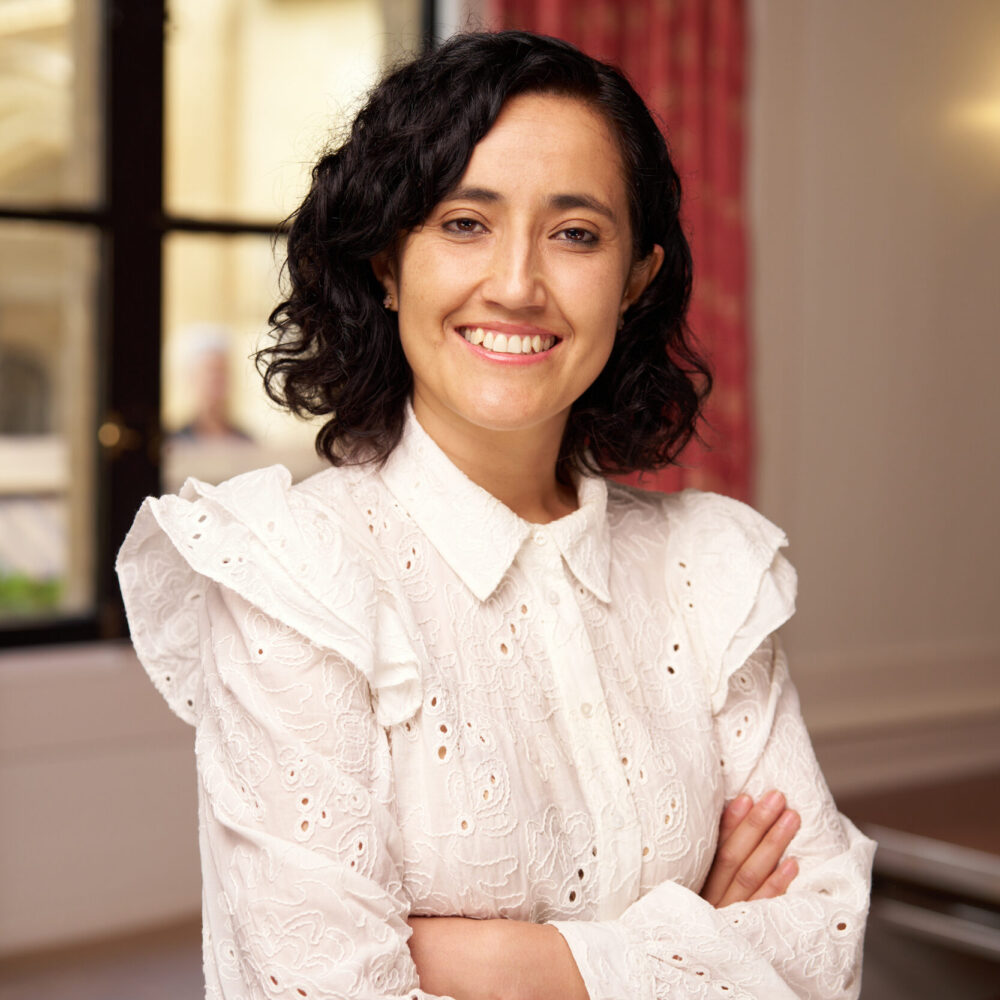
Dr Sandra Araya Rojas
BA MA Chile, MA Barcelona, MA Madrid, PhD KCL
Stipendiary Lecturer
I am a scholar of Latin American cultural studies. Before joining Brasenose, my academic career included teaching and research at the University of Wisconsin–Madison, Brooklyn College and King’s College London, where I most recently held a Leverhulme-funded post in Latin American Cultural Studies and Spanish Language. Alongside my academic work, I have sought to make language education and cultural heritage more accessible beyond the university: I taught Spanish to refugee-background women in Barcelona and developed a digitisation project on the Anglican missionary school in Cholchol, which was shortlisted for the British Library’s Endangered Archives Programme. My research explores Protestant women’s cultural production in the nineteenth- and early twentieth-century Americas, with interests in manuscript culture, evangelical women’s periodicals, and the connections between scientific writing, Christian feminisms and Indigenous identities. My research has included funded stays at the New York Public Library, Wright Library (Princeton) and the Newberry Library (Chicago), and has culminated in my first monograph, Dissident Scribes: Literary Education and the Spiritual Legacies of Protestant Missionary Women in the Americas (1848–1939). I am currently a Visiting Research Fellow at King’s, where I am completing the manuscript.
I am a Lecturer in Spanish at Balliol and Brasenose Colleges, where I teach Spanish language and literature.
I teach the full Prelims course for students in Spanish at Brasenose and Balliol, as well as FHS Papers I, II, XIV, and all Spanish American options for Papers VIII and XI.
What I value about teaching Spanish is the opportunity to bring language, literature and culture into dialogue, and to ask students to think critically about the assumptions that shape how languages and cultures are understood. In my teaching, I have particularly sought to broaden students’ understanding of the Spanish-speaking world beyond national and Eurocentric frameworks, bringing in perspectives shaped by colonialism, migration and cultural difference. Oxford’s tutorial system is especially well suited to this kind of teaching. Working with students in small groups over a sustained period allows me to follow their particular interests, challenge their readings and help them build arguments of their own. I see the tutorial as a space where students become contributors to knowledge, rather than simply recipients of it. At Brasenose, my aim is to help students recognise that what the texts we read present as fixed often conceals specific forms of power, shaped by particular historical contexts, and that language itself can be a source of empowerment.
My first book project, Dissident Scribes: Literary Education and the Spiritual Legacies of Protestant Missionary Women in the Americas (1848–1939), offers the first study of women’s missionary writing in Latin America. It reappraises travel writing as a site of spiritual intimacy and feminist critique, rather than solely as an expression of imperial authority, and uncovers a transatlantic network of women whose domestic writings shaped debates on egalitarian priesthood, religious liberty and modernity. My current research examines the role of Methodist women educators in the modernisation of Chile. One strand explores the vocabulary of pleasure as a way of articulating ideals of sexual purity in the first novel written in English by a Chilean student. A second strand examines the paradoxes of Christian feminism in discussions of food and nutrition, where hygienist ideas about Mapuche women’s bodies intersected with anti-Nazi positions in a political context shaped by the Spanish Civil War and campaigns for women’s suffrage. This research brings together Modern Languages, Religious Studies and English, and has led to invited talks and collaborative initiatives in Europe, the United States and Chile.
- Resisting“Brutish Maleness”: The Vocabulary of Pleasure in Lelia Waterhouse’s Love Letters, in C. Broomer (ed.), Women in Twentieth Century Literature and Religion London: Routledge (forthcoming in November 2026)
- Screening Wounded Motherhood: Pedagogy and Social Exclusion in Valparaíso mi amor, Entre Hojas: Revista de Estudios Hispánicos (submitted).
- Ten Years On: José Ricardo Morales, Exile, and His Legacy in Chilean Theatre, Artifara: Revista de lenguas y literaturas ibéricas y latinoamericanas (submitted).
- “Representaciones de la realidad y escritura en el cuento español contemporáneo: Ignacio Aldecoa y José María Merino.” Diálogos Transatlánticos, Vol. 4, Universidad Nacional de La Plata, Argentina, 2012.
- “Constatación de una coherencia textual en los últimos capítulos del Quijote de 1605.” Cuadernos Cervantinos, Universidad de Chile, 2010.
- “Tracing Threads of Faith: Researching Protestant Women at the New York Public Library.” The Society for Latin American Studies, July 2025, https://www.slasuk.org/post/tracing-threads-of-faith-researching-protestant-women-at-the-new-york-public-library (public-facing writing)
- “Journeying Mercies.” Curator of the Virtual Exhibition Stories of Strand-Aldwych. King’s College London Archives, August 2022, https://kingscollections.org/exhibitions/archives/stories-of-strand-aldwych/tradespeople-and-nurses/journeying-mercies (public-facing writing)
- “Your loving scholar”: motherhood and affects in One of God’s Lilies. Talking Humanities, July 2021, https://talkinghumanities.blogs.sas.ac.uk/2021/07/13/your-loving-scholar-motherhood-and-affects-in-one-of-gods-lilies/ (public-facing writing)