
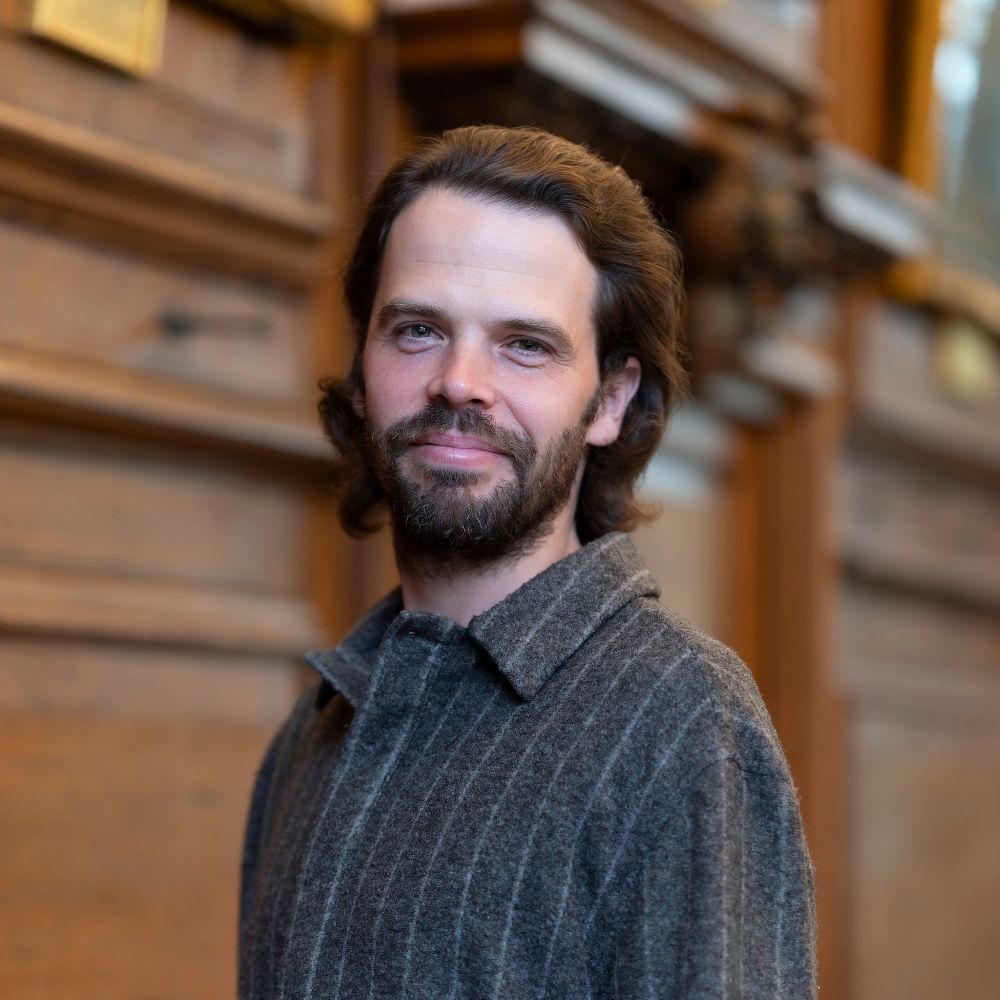
Professor Dejan Draschkow
BSc, MSc Munich, PhD Frankfurt
Tutorial Fellow
I grew up in Sofia, Bulgaria, before studying in Munich and Frankfurt, where I completed my PhD and later held an Interim Professorship. My research has also taken me on extended stays in France, Scottland and the US, and I’ve been lucky to work with inspiring colleagues around the world.
Today I’m an Associate Professor at the Department of Experimental Psychology and a Tutorial Fellow at Brasenose.
I lead the Adaptive Behaviour & Cognition Lab, where my team and I study how attention and memory work together in everyday life, often using tools like virtual reality, EEG/MEG, and eye-tracking. I care deeply about open and transparent science, and I’m passionate about teaching — whether that’s in the classroom, through public engagement, or one-on-one mentoring.
For the department, I teach Advanced Quantitive Methods for postgraduates and Experimental Core Practicals for undergraduates. I also lead the Preparing for Teaching in Psychology (PTP) course in the department, which helps new teachers get started with teaching in Oxford. For college, I lead tutorials in Experimental Psychology (EP) and Psychology, Philosophy & Linguistics (PPL).
I am proud to have received the Early Career Excellent Teacher Award from Oxford’s Medical Sciences Division, as well as an “1822-Universitätspreis” for excellent teaching — one of the oldest teaching prizes in Germany.
My research focuses on how attention and memory work together to support the way we experience and interact with the world. I am particularly interested in how memory guides attention in real time, how our experiences are encoded and reshaped by what we notice, and how these processes allow us to act adaptively in complex and changing environments. Rather than studying these questions in highly simplified settings alone, I aim to capture the richness of everyday life in the lab.
To do this, my team and I use a broad range of methods, from traditional approaches such as eye-tracking, psychophysics, and EEG/MEG, to innovative techniques like virtual and extended reality. These tools allow us to study behaviour in immersive, naturalistic situations while maintaining scientific control. By combining them, we can explore how people perceive, remember, and act in real-world contexts — for example, how they search for objects in a room, search for objects in their minds, navigate environments, or draw on memory to predict what will happen next.
A central thread throughout all of my work is a commitment to open and reproducible science. I am involved in departmental and university-wide initiatives to improve transparency and collaboration, and I encourage my students and colleagues to adopt best practices in data sharing and reproducible methods. Ultimately, my goal is not only to understand the fundamental mechanisms of attention and memory, but also to build a research culture that is more reliable, creative, and inclusive.
https://www.psy.ox.ac.uk/research/adaptive-behaviour-cognition
Kumle, L., Nobre, A. C., & Draschkow, D. (2025). Sensorimnemonic decisions: choosing memories vs sensory information. Trends in Cognitive Sciences. Volume 29, Issue 4, 311 – 313. 10.1016/j.tics.2024.12.010
Kumle, L., Kovoor, J., Watt, R. L., Boettcher, S. E. P., Nobre, A. C., & Draschkow, D. (2025). Long-term memory facilitates spontaneous memory usage through multiple pathways. Current Biology. https://doi.org/10.1016/j.cub.2025.01.045
Gong, D., Draschkow, D. & Nobre, A.C. (2025). Focusing attention in working and long-term memory through dissociable mechanisms. Nature Communications. 16, 4126. https://doi.org/10.1038/s41467-025-59359-0
Thom, J., Nobre, A. C., van Ede, F., & Draschkow, D. (2023). Heading direction tracks internally directed selective attention in visual working memory. Journal of Cognitive Neuroscience. https://doi.org/10.1162/jocn_a_01976
Draschkow, D. (2022). Remote virtual reality as a tool for increasing external validity. Nature Reviews Psychology, 1–2. https://doi.org/10.1038/s44159-022-00082-8
Draschkow, D., Nobre, A. C., & van Ede, F. (2022). Multiple spatial frames for immersive working memory. Nature Human Behavior, 1–9. https://doi.org/10.1038/s41562-021-01245-y
Helbing, J., Draschkow*, D., & Võ*, M. L.-H. (2022). Auxiliary scene context information provided by anchor objects guides attention and locomotion in natural search behavior. Psychological Science. https://doi.org/10.1177/09567976221091838
Draschkow, D., Kallmayer, M., & Nobre, A. C. (2021). When natural behaviour engages working memory. Current Biology, 31(4), 869-874.e5. https://doi.org/10.1016/j.cub.2020.11.013
Kumle, L., Võ, M. L., & Draschkow, D. (2021). Estimating power in (generalized) linear mixed models: an open introduction and tutorial in R. Behavior Research Methods. https://doi.org/10.3758/s13428-021-01546-0
Võ, M. L.-H., Boettcher, S. E. P., & Draschkow, D. (2019). Reading Scenes: How Scene Grammar Guides Attention and Aids Perception in Real-World Environments. Current Opinion in Psychology. https://doi.org/10.1016/j.copsyc.2019.03.009
Sassenhagen, J. & Draschkow, D. (2019). Cluster-based permutation tests of MEG/EEG data do not establish significance of effect latency or location. Psychophysiology. 2019;e13335. https://doi.org/10.1111/psyp.13335
https://scholar.google.de/citations?user=yV2uzYMAAAAJ&hl=de&oi=ao