
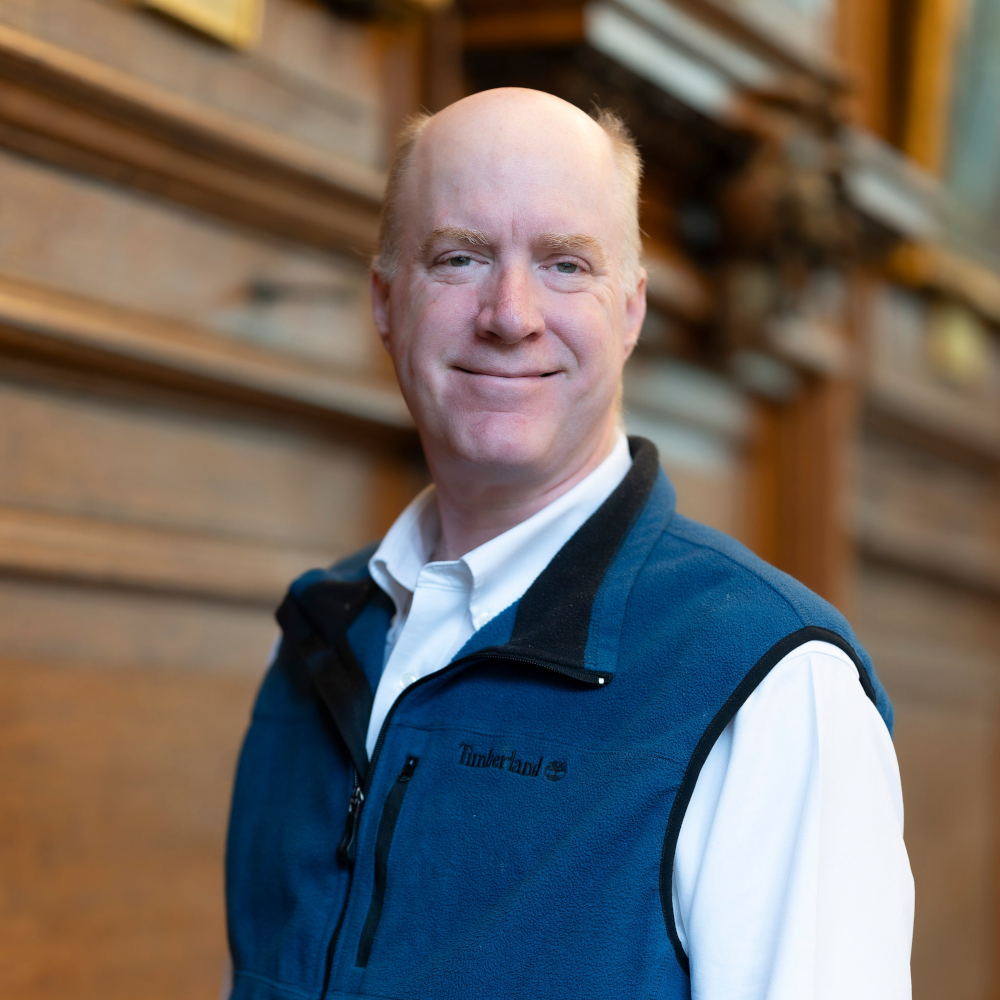
Professor Christopher McKenna
BA Amherst, PhD Johns Hopkins, FRHistS
Tutorial Fellow
Although I was born in the UK, I grew up outside Philadelphia on the East Coast of the United States. After undergraduate study at Amherst College in economics (and a brief stint in Oxford), I initially worked in finance on Wall Street and the City in London before I decided to do a doctorate at the Johns Hopkins University on the history of business and technology. As I was completing my PhD, I taught management at the Wharton Business School in Philadelphia, and, in 2000, I moved to Oxford where I tutor in Brasenose and lecture in the Said Business School. Over the past 25 years, I have won a variety of awards for my teaching and scholarship.
My teaching and supervision focus on global business history, corporate reputation, and white-collar crime. I currently supervise doctoral students on a variety of subjects, including the history of transportation, the history of technology, and the historical impact of consultants. I am particularly interested in how corporate reputation and legitimacy are constructed and defended over time, and how these processes intersect with broader patterns in the development of capitalism and state regulation.
Alongside my research and teaching in Oxford, I have held visiting appointments in both Europe and North America. In Oxford, I co-direct the Global History of Capitalism, based in the Global History Centre, which has produced an open access series (www.ghoc.org.uk) of case study teaching materials to support teaching around the world. I particularly enjoy working with undergraduates to write new cases to add the global breadth of online cases.
Outside academic life, I divide my time between Oxford and summers on the coast of Maine.
I teach optional courses to E&M undergraduates, MBAs, and Executive MBAs on the history of business.
The business history elective, taught to 2nd and 3rd-year students, is focused on the three industrial revolutions around the globe, with a particular emphasis on using Oxford as a way to demonstrate the changes over time. Students visit a variety of places within the university and city and are introduced to the transformative technologies and institutions in the modern global economy.
I enjoy teaching in Oxford because I am encouraged to work very closely with students in a historical setting that facilitates interactive teaching. Visiting museums, lecturing on a boat, or even viewing a priceless collection, are easily integrated into a course and accompanied by small group tutorials. Oxford’s remarkable academic interdisciplinarity, collegiate integration, and internationalism are extraordinary even when compared with other great universities. I particularly enjoy using all of the great features of the university to make the teaching experience all the more vivid and memorable.
My research looks at how modern capitalism took shape through the rise of professional and corporate institutions. I’m particularly interested in how firms like consultancies and other professional service organisations helped define what management and expertise mean in business today. As Co-Director of the Global History of Capitalism Project at Oxford, I work on understanding how global business systems developed over time and how history can help us think differently about current debates in strategy and corporate responsibility. I like combining deep archival work with questions that still matter for companies and society now—things like how firms build legitimacy, handle crises, and shape the rules of the economic game.
My first book, The World’s Newest Profession, explored how management consultants became such a powerful part of modern business life, and it led me to think more broadly about the role of expertise in capitalism. Since then, I’ve co-edited work on corporate reputation and the historical responsibilities of business in society, and I’ve helped create a collection of more than thirty-five global case studies at the Global History of Capitalism website. I am currently finishing a book on the global history of white collar crime, Partners in Crime, for Simon & Schuster that starts with a portrait in Brasenose and ends with the Trump presidency. Across all of this, I try to use history to make sense of how organisations gained trust, influence, and authority; and what that tells us about the moral and social underpinnings of business today.
“The Historical Role of the Corporation in Society,” Journal of the British Academy (2018).
“Corporate Reputation in Historical Perspective,” Business History Review, Vol. 87, Issue 4 (Winter 2013).
The World’s Newest Profession: Management Consulting in the Twentieth Century (New York: Cambridge University Press, 2006).
“‘Better Living Through Chemistry?’ Industrial Accidents and Masculinity at DuPont, 1890-1930,” Entreprises et Histoire, Number 17 (December 1997): 9-21.