
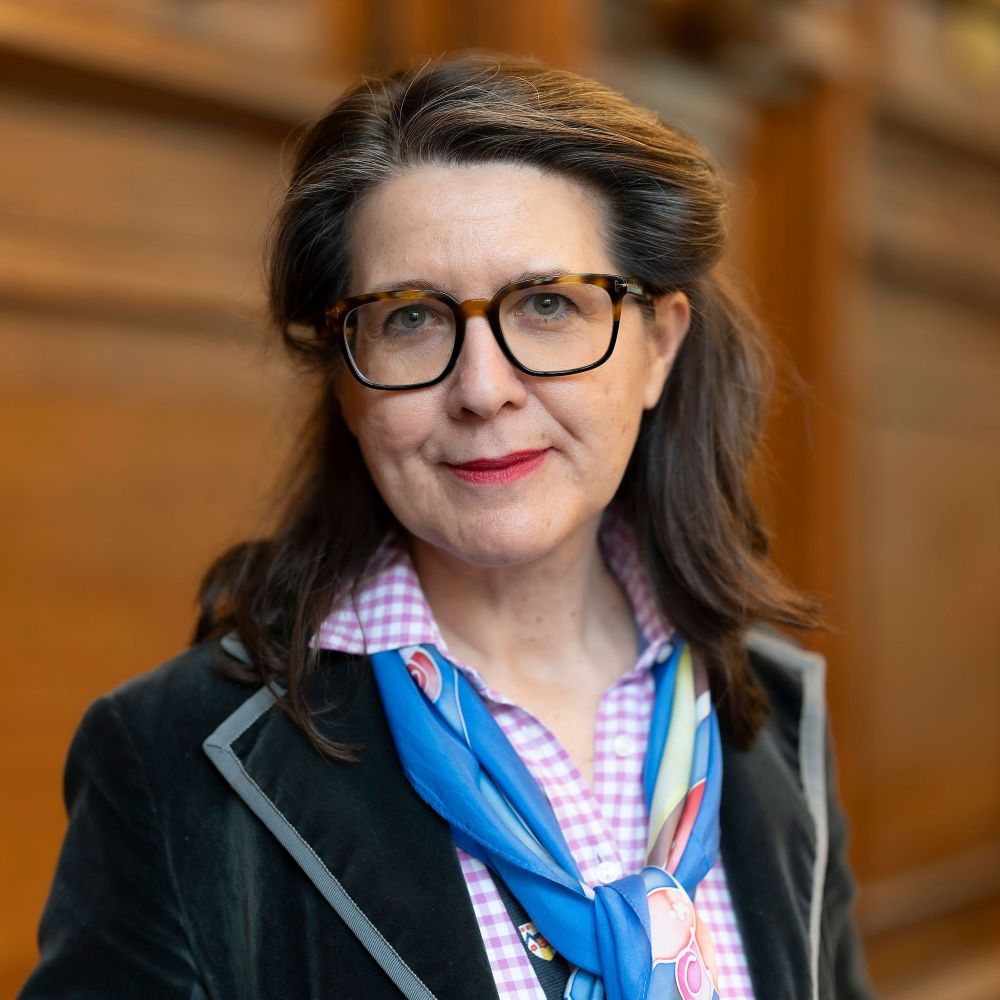
Professor Carole Bourne-Taylor
MA Grenoble-Alpes, DEA-Diplôme d’Études approfondies Grenoble-Alpes, MA Oxon, PhD (Grenoble-Alpes)
Supernumerary Fellow
I am the Fellow and Tutor in French and an Associate Professor, overseeing the teaching of French at Brasenose. I am a Member of French Sub-Faculty and Congregation and of SOAS GLOCAL Scientific Committee.
I also hold the office of Curator of the Senior Common Room.
The first highlight in my academic career was a scholarship (Allocation de Recherche) and a Monitorat d’Enseignement Supérieur from the Ministry of Research with its concomitant training throughout my PhD within the Centre d’Initiation à l’Enseignement Supérieur (1992-95). As an allocataire-monitrice (Junior Research Fellow), I taught French literature and culture, as well as comparative literature. I was then a Lecturer in English/American Literature at Montpellier/Nîmes (1995-96). This early experience proved a solid grounding for Oxford, where I was a Lectrice and Lecturer in French at various colleges for several years and a Research Assistant to Malcolm Bowie, Marshal Foch Professor at All Souls (1999-2001), before being appointed to a Fellowship at Brasenose in 2009 and an Associate Professorship in 2021.
I have held visiting Professorships at Vilnius University and Université Libre de Bruxelles-MODERNITAS research centre, as well as a Senior Research Fellowship at the Maison de la Création et de l’Innovation, Grenoble-Alpes – funded by the French Government’s Programme d’Investissement Avenir and implemented by the Agence Nationale de la Recherche ANR France 2030.
My professional development transcends my academic qualifications and includes training in various kinds of “awareness” to support students and colleagues better – Trans Awareness Training (Gendered Intelligence) and Mental Health Awareness Training. I have Certificates in Mental Health Awareness Training for Managers, Assessing Mental Capacity and Deprivation of Liberty Safeguards and I attend webinars run by the Social Care Institute for Excellence.
I teach French/Francophone literature from the nineteenth century to the present. For Prelims: short texts and narrative fiction (Papers III and IV). At FHS level: French and Francophone literature of the 19th, 20th, and 21st centuries (Paper VIII), some modern and contemporary “Prescribed Authors” (Paper XI), Special Subjects (XII) on 19th-21st-century French poetry and the Dissertation (Paper XIV). I also teach formal grammar and prose translation.
At the postgraduate level, I teach seminars on “Poetry and Ethics” for the MSt/MPhil. I have supervised DPhil theses on comparative literature (Baudelaire and Virginia Woolf; Flaubert and Faulkner), on ‘troubled’ récits de filiation in the 21st-century; on The Construction of Balzac as a Classic Writer; as well as MSt/MPhil theses on intersections of 19th-to-21st-century French/Francophone literature and ethics, literature and the performing arts, literature and phenomenology (19th-21st c.) and comparative studies.
I welcome applications from excellent students from all corners of the world and from all walks of life.
Much of my research focuses on comparative literature, literature and phenomenology, the performing arts, the problematics of mourning and modern/contemporary poetry. My most recent project consists in making all my interests coalesce in the pluridisciplinary topic of habitability. Another aspect of my research involves creative writing workshops with French poet Emmanuel Merle, which is incredibly fun, fruitful and mindful.
The French course at Oxford is diverse, challenging and stimulating; it is bound to feed your inquisitiveness and turn you into a culture detective! We study literature both in its own right and within its context and explore the rich cultural tradition underpinning the language. You will realise that your frame of reference is infinitely flexible and fed by the complex and messy history of our civilisation. It is more than just learning how to tune your instrument to replicate sounds and effects! It is an intellectual adventure into unknown territories which will make you a more alert and altruistic person through exposure to another culture and scale of values. I have regularly promoted the study of Modern Languages in The Times letters page.
Primarily inspirational, the tutorial system is unique and Oxford’s main asset. I see my role as a catalyst whose duty is to make things happen and fan the fire of my students’ passions. It is a privilege to nurture the development of bright young minds and facilitate deeper, broader and more flexible thinking. Pastoral care is as important as intellectual inspiration: I take both roles very seriously. Students invariably thrive within the tutorial system, honing their speaking, writing and critical skills (in both French and English), gaining confidence and maturity and refining their sensitivity to the world that awaits them beyond their degree. The benefit of the tutorial system is long-lasting: it unlocks doors that will remain open forever.
French offers an awful lot of choice — from romanticism to feminism, from queer studies to ecopoet(h)ics etc. : j’en passe et des meilleurs, as Victor Hugo would say — it is eclectic, ever-expanding and enriching. It will introduce you to a variety of voices, ideas and perspectives. I love every aspect (and every minute!) of my teaching, especially the literature papers at FHS level. But translation is also fun. Language and literature, theory and practice are inevitably intertwined: grappling with the intricacies of language illuminates the mechanics of literature in the same way as close textual analysis provides an insight into grammatical, lexical and stylistic resources and their deployment to optimal effect. Even grammar is great! Its nuts and bolts will order and open your mind in ways that will surprise you. Your ears and eyes will become attuned to the subtleties of syntax, the pertinence of punctuation and the art of an adequate adverb! The lasting legacy is an attention for detail and an ability to transcend your own ethnolinguistic background and open your mind to ideas you had not thought possible.
Key qualities: I am looking for candidates who are intelligent, diligent and eloquent; curious and ambitious, scholarly and sensitive; candidates with a genuine commitment to open debate and inquiry and eager to embrace opportunities outside their comfort zone. If you enjoy reading, thinking and writing, then this is a course for you! I want to tickle your curiosity, stretch your mind and nurture your passion for learning.
L’Univers imaginaire de Virginia Woolf (preface by Jean Guiguet; postface by Gilbert Durand), Paris, Editions du Temps, 2001. Read a review by Constance Hunting in the Virginia Woolf Bulletin no. 10 (May 2002)
Other publications on Virginia Woolf include:
– ‘The French Reception of Woolf: An État Présent of Etudes Woolfiennes’, in M-A. Caws & Nicola Luckhurst (eds.), The Reception of Virginia Woolf in Europe, London, Continuum, 2002.
– ‘The Ekstasis of Influence: Virginia Woolf’s Mediterranean Experience’, in Bryony Randall & J. Goldman (eds), Virginia Woolf in Context, CUP, 2013.
– ‘“The Journey is everything’: Virginia Woolf’s Continental Adventure”, in Ariane Mildenberg & Patricia Novillo-Corvalan (eds), Virginia Woolf, Europe and Peace, Clemson University Press [28th Annual International Conference, Kent University, June 2018]. 2020.
Phenomenology, Modernism and Beyond, edited with Ariane Mildenberg (preface by Kevin Hart), Oxford, Peter Lang, 2010. It includes my chapter, ‘Figures of Immanence/Imminence: “Enigma Variations” in Michel Deguy’s works’.
Reviews in Tijdschrift voor Filosofie 73 (4), 2011; Modernist Cultures 6 (2), October 2011; Comparative Critical Studies 9 (2), June 2012; Modern Fiction Studies 58 (1), Spring 2012; The Modern Language Review, 107 (4), October 2012; The Years Work in English Studies 92 (1), 2013.
Introductions to Charles Morgan’s Three Plays and Dramatic Critic. Selected Reviews 1922-39, London, Oberon, 2013. http://www.theartsshelf.com/2013/05/14/oberon-books-celebrate-dramatic-critic-charles-morgan-with-two-new-releases/
Review of Three Plays and Dramatic Critic from the Times Literary Supplement, 22 Jan 2014
(My peripheral interest in the life and work of Charles Langbridge Morgan – The Times drama critic and alumnus of Brasenose College led to a lecture at the Oxford & Cambridge Club on 1st April 2014. See The Brazen Nose, (Volume 44, 2009-10, p. 120-7) for a snippet of Morgan’s art.)
The bulk of my more recent work has focused on poethic figurations of grief and mourning and their status within an exploration of the kinship between literature and life and the search for ethical restitution.
Variations on The Ethics of Mourning in Modern Literature in French, edited with Sara-Louise Cooper (preface by Dominique Rabaté), Peter Lang, 2021 (see review (1) here, (2) here, and (3) here. My own contribution includes the critical introduction and a chapter on the poets Emmanuel Merle and Yves Bonnefoy.
I have published numerous articles/chapters/reviews on a variety of topics and authors: Shakespeare, Walter Scott, Katherine Mansfield, Arthur Miller, Paul Auster, Lady Anne Blunt, Paul Valéry, Michel Deguy, Yves Bonnefoy, Emmanuel Merle, Michel Houellebecq, Sarah Bernhardt, Kamel Daoud, Annie Ernaux and…Nation Branding (Cool Britannia).
Another interest of mine is the performing arts (drama and music and their phenomenological unfurling of the written text). In this vein, I have published an article on the Cambridge composer Jeremy Thurlow’s adaptations of Yves Bonnefoy’s poetry to music and I am currently writing a biography of Alice Sapritch (to be published by the Éditions Garnier, Paris).