


Dr Camilla Di Mino
BSc Rome, MSc Rome, PhD UCL
Stipendiary Lecturer
I grew up in Manziana (Rome), where I regulary go back to visit friends and family. I did both my BSc and MSc at Università Roma Tre where I graduated with Honours in Condensed Matter Physics (2018) . I then moved to London for my PhD in UCL before moving to Oxford as a PDRA in Materials (2023-2025) and EPSRC/Glasstone Research Fellow in Chemistry (2025 – ).
I am the Glasstone Research Fellow in Chemistry, my work aims to understand the molecular structure of liquid systems to target desirable macroscopic properties, from biological mechanisms to the optimisation of battery electrolytes formulations. I am currently based in the Physical and Theoretical Chemistry Laboratory.
In Brasenose, I am a Stipendiary Lecturer, who teaches mathematics for first year chemists.
The central pillar of my research is gaining a fundamental understanding of competitive intermolecular interactions and solvation patterns in liquids. Model systems of iteratively increasing complexity are selected to target interactions with specific applied systems in mind. To date I have focused on aromatics and substituted aromatics which underpin protein frameworks (benzene, Nat Comm 2023; phenols, ChemRxiv 2025), sulfur heteroaromatics for plastic electronics (thiophenes, Phys. Chem. Chem. Phys. 2023), industrially relevant solvents (DMF/DMSO, J. Phys. Chem. B 2023), and battery electrolytes (ACS Energy Lett. 2024).
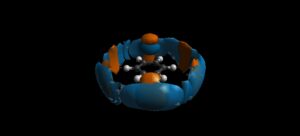
Weak Cooperative Interactions
Neutron scattering plays a critical role in my research as it allows me to disentangle energetically comparable molecular behaviours, due to its unique sensitivity to hydrogens, absent in X-ray and electron diffraction techniques. Our experimental data can reveal subtle molecular mechanisms and strong molecular structuring that simulations alone cannot often predict. Nat. Commun. 2023
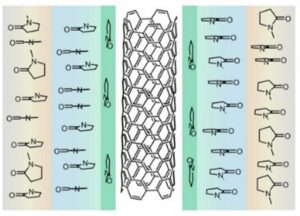
Liquid/Nanomaterial Interfaces
The main experimental challenge of studying liquids at interfaces is the small fraction of solvent at the surface relative to the bulk, which dominates the measurement. One way to overcome this challenge is to investigate liquid suspensions of nanomaterials, where, thanks to their high surface to volume ratio, the scattering signal from the monolayer increases up to a significant 10 % of the total. In this manner, I can extract an atomistic picture of the interface providing unique information, e.g., for the use of these materials as energy storage capacitors. Nat. Nanotechnol. 2025