
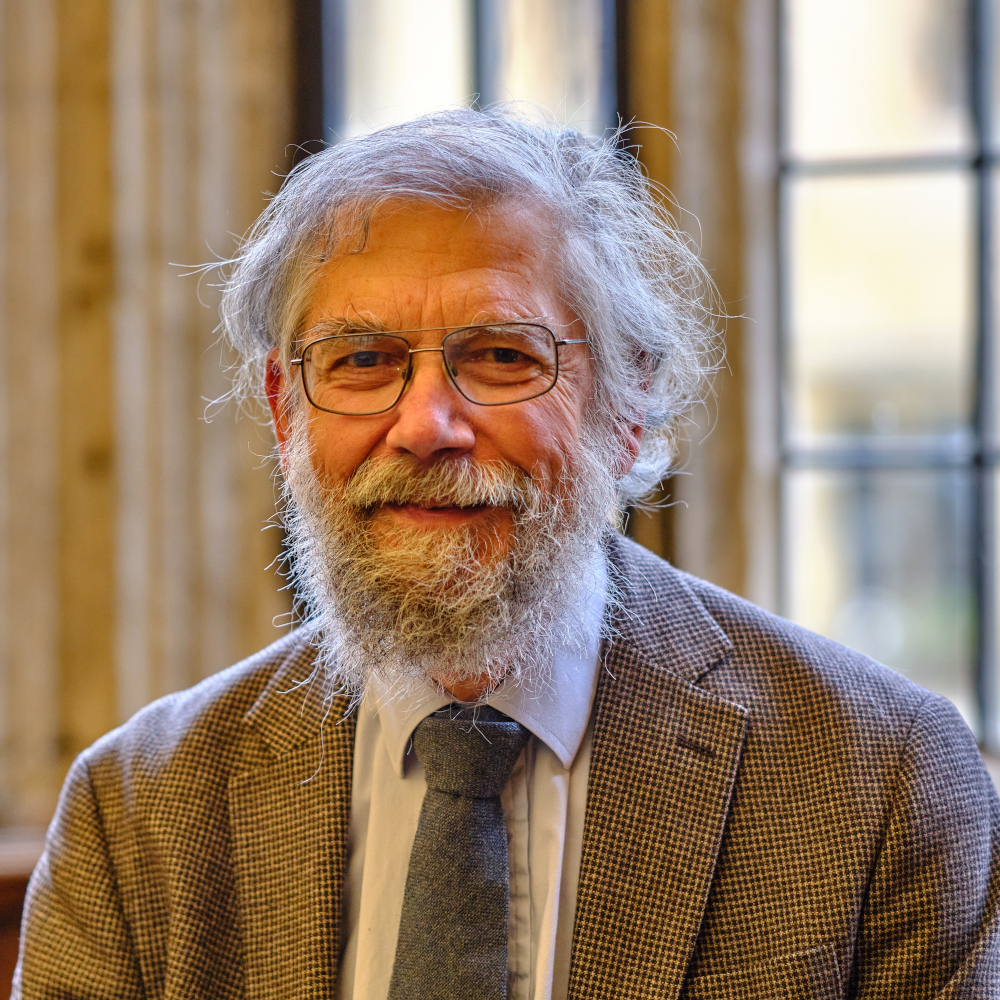
Dr Anthony Harker
MA Camb, DPhil Oxf, F Inst P
Lecturer
After reading Natural Sciences at Cambridge, specialising in Theoretical Physics, I moved to Oxford to study for a DPhil in the same subject. After graduating I spent a year in Germany on a Royal Society European Fellowship, before returning to a job in the Theoretical Physics Division of the UK Atomic Energy Authority at Harwell. I that stimulating environment I worked on a topics ranging from the quantum mechanical structure of defects in solids to the use of ultrasound to inspect the gas pipelines. As the Atomic Energy Authority moved into privatisation the role of theoretical physics was reduced, and when I left in 1995 I was in charge of a much reduced department. It was while I was at Harwell that I first became a College Lecturer at Brasenose.
The second half of my career was in the Department of Physics and Astronomy at University College London (UCL), where I continued research in a variety of areas, including silicon-based quantum computation and the nondestructive testing of fibre-reinforced composite materials. I taught courses on Waves and Optics, Solid State Physics, and Computational Physics. When I retired from UCL in 2013 I was deputy head of department.
Retirement might be the wrong word: since then I have enjoyed a very productive collaboration with the Mechanical Engineering Department at UCL, on topics ranging from the analysis of video images to diagnose eye conditions to modelling the manufacture and performance of drug-loaded fibres and nanoparticles. I am also a consultant to EDF Energy on prolonging the life of the UK fleet of Advanced Gas-cooled nuclear Reactors.
I teach the Solid State Physics course in the third year.
One feature of Solid State Physics is that it builds on almost all the physics and mathematics that you will have learnt in earlier years. If you enter year three looking back at the previous two years and asking “why did we learn that?” this may be where you find out.
My research has ranged over quantum mechanical modelling (defects in solids; quantum computing), materials science, nondestructive evaluation of materials, applications of statistical techniques in materials science, manufacturing methods for fibres and nanoparticles, and other topics.