College buildings
SCROLL TO EXPLORE


SCROLL TO EXPLORE
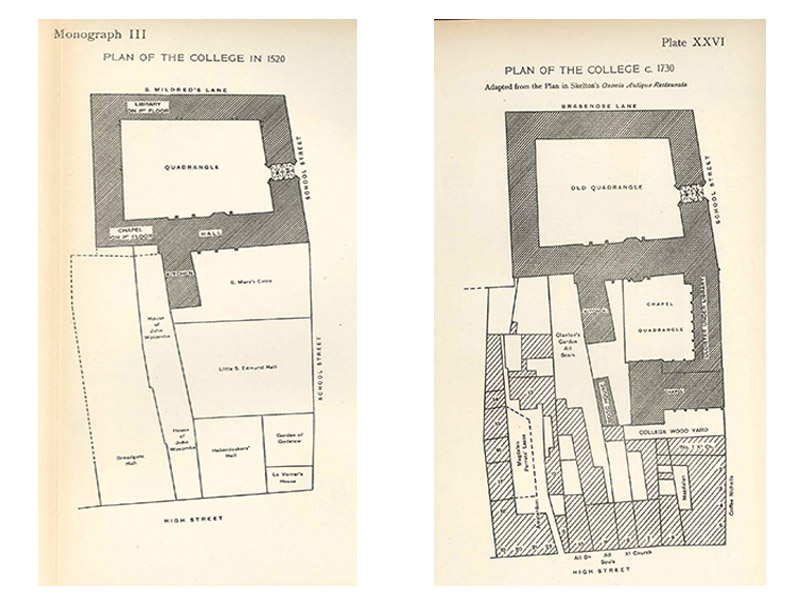
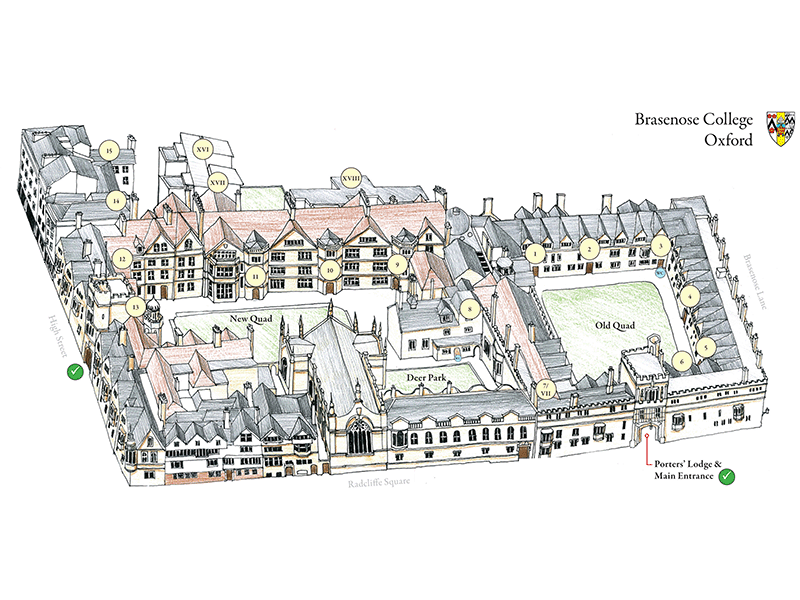
For more than the first hundred years of its existence, the College consisted of just one quadrangle (Old Quad), which was two storeys high. We do not have an exact date of construction, but the foundation stone was laid in 1509, and the Tower roof was completed around 1520-1522. The buildings were handed over to College in 1516 by founder Bishop Smyth (who seems to have been responsible for the works). The only structure to extend beyond Old Quad was the 15th century kitchen (now called Medieval Kitchen), which is thought to have been inherited from College’s predecessor, Brasenose Hall.
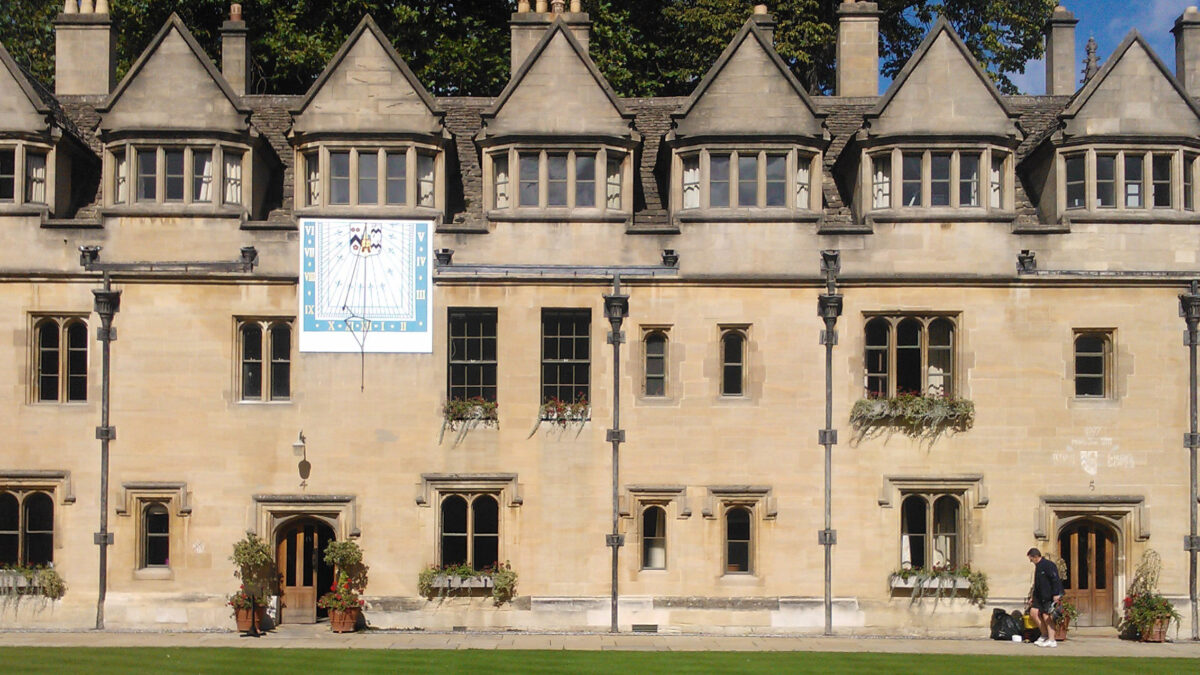
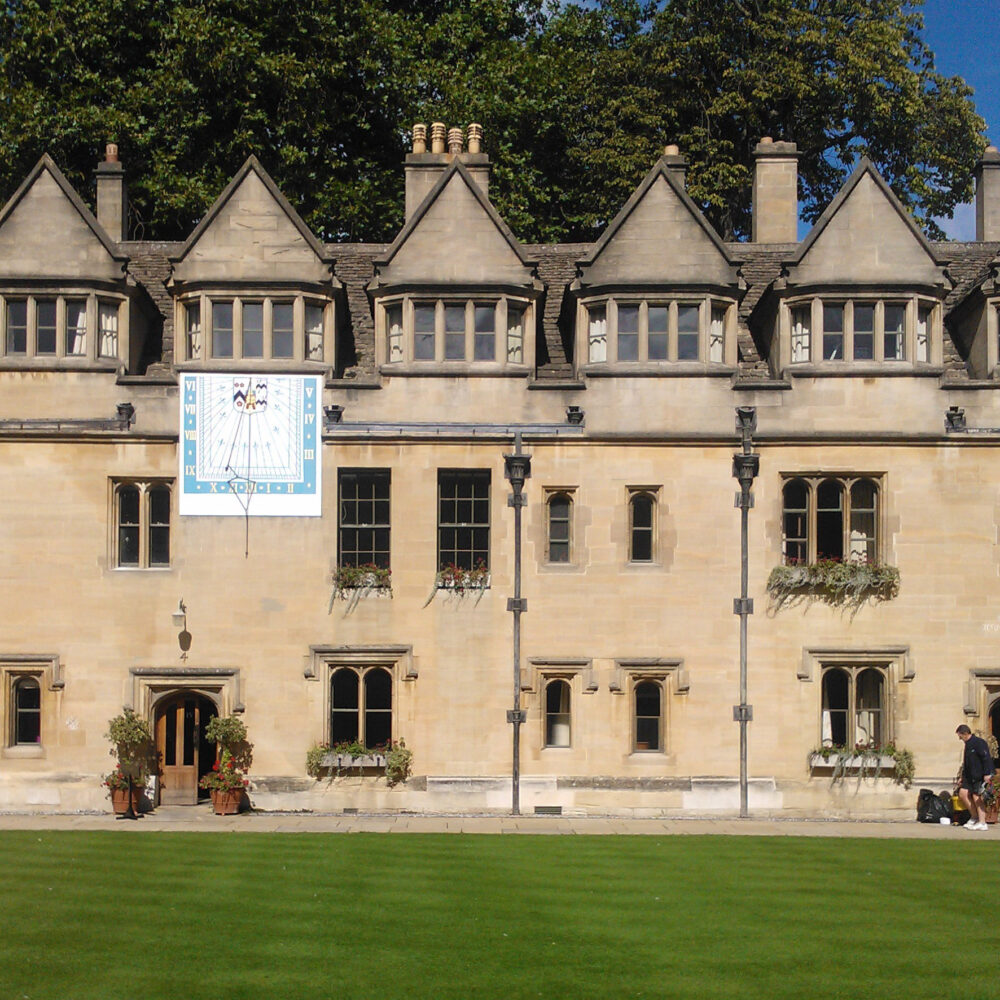
The Chapel was on the southwest corner, the site of the present Senior Common Room, and opposite was the Library on the first floor in the area now behind the sundial (which itself has been in place since at least the 1670s; the current version is thought to date from 1719). The staircases in the College were numbered from at least the 18th century; those on Old Quad are numbered 1-8. The Main Porter’s Lodge, the Hall and the Senior Common Room have always been on Old Quad.
In the centre of Old Quad was a sort of knot garden surrounded by a low ornamental wall, as evidenced by David Loggan’s engraving of Brasenose dated 1674. In October 1727, the garden was removed, and Thomas Hearne (1678-1735) recorded the fact with great indignation. He said that the garden was ‘the only one of that kind then remaining in Oxford’ and that it ‘was a delightful & pleasant Shade in Summer Time. This is done purely to turn it into a Grass Plot, & to erect some silly Statue there.’ The silly statue in question was known in the College from the beginning as ‘Cain and Abel’, although subsequently it was identified as a copy of a work by John of Bologna depicting Samson slaying a Philistine; a version in marble can still be seen in the Victoria and Albert Museum. The College’s copy was purchased in London and brought to Oxford by barge. It was finally removed in 1881. It had proved a great temptation to the students and had been painted or otherwise adorned on many occasions.
The Tower was a much more imposing structure than it seems today, with only two storied buildings surrounding it, no Bodleian Quadrangle, and there was a tangle of tenements and gardens where the Radcliffe Camera now stands. By the 17th century the College was running out of space, and the solution was to build a third storey, which seems to have been started in about 1614 and took some 20 years to complete. Around the same time several new cellars were dug, and the expansion out of Old Quad continued with the opening of the new Library in about 1664 and the consecration of the new Chapel in 1666. Space was also made with the purchase of a house on the High Street in 1771, which was adapted to make a new Lodging for the Principal.
The Principal’s Lodgings were originally spread out between either side of the Old Quad Tower, on the first floor. The original front door can still be seen just inside the quadrangle. The former lodgings on Old Quad became known as the Old Lodgings or ‘Old Lodge’; a notebook records that ‘the Old Lodge was divided and fitted up for the Reception of Fellows & others,’ and an Old Lodge staircase first appears in the Room books at the beginning of 1773. These rooms included what is now the Stocker room (instituted in the 1960s), the whole of what is now the History Library and the other rooms on Staircase 7. The Bursary and Bursar’s offices were then located in Old Lodge until the 1950s.
On 14 February 1950, a fire broke out (in what is now the History Library) and destroyed most of the area known as Old Lodge. At this point the area was renovated with the History Library being added on the top floor. The Bursary was relocated to St Mary’s (just off New Quad) at this time. In the late 1950s, the Principal returned to the Old Quadrangle but to much smaller quarters than before, concentrated on the north side of the Tower.
Prior to this, the Principal’s Lodgings had been located variously in New Quad. The only extensive building work to be carried out in the 18th century was a new Lodging for the Principal, into which he moved at Michaelmas 1771 with his wife and household. It was not a new building but was adapted from existing property in which wide-ranging work was carried out. A photograph taken in 1887 before its demolition shows a three-storey house, plus attics, with five window bays. The bills for the work mention at least sixteen rooms, including two parlours and two dining rooms. There were two staircases (one with pilasters, arches and ‘cupelo over’) and substantial domestic accommodation.
The new Library and Chapel were built between 1655 and 1666 in the area now known as Deer Park (once known as Chapel Quad), the small quadrangle in between Old Quad and New Quad. Principal Samuel Radcliffe, who was responsible for at least some of the existing expansion of Old Quad in addition to many other improvements, had envisaged a second quadrangle to the south east of the kitchen and left money in his will of 1648 to create the Chapel and also ‘a buildinge upon Pillars … which will make a walke under it, ye great want of Brasennose Colledge’ [the Library and Cloisters].
The open cloisters underneath the Library provided shelter for exercise in bad weather, and it was also the College’s burial ground. In 1807, they were turned into a set of four rooms to provide more accommodation for students. The work is thought to have been completed by Sir John Soane. Between 1972 and 2008, the rooms became the Hulme Common Room for graduate students. In 2015, work started on an extension to the Library, which expanded into the Cloisters below. The space was designed by architects Lee Fitzgerald and was completed in 2017.
In due course the second quadrangle envisaged by Principal Radcliffe was nicknamed ‘Deer Park’. This is usually seen as a joke, and C.C. Bradford (matriculated 1884) gave a date to this in the Brazen Nose magazine of 1934. He claimed that in 1886 he was walking through Chapel Quad with R.H Tilney (matriculated 1885), discussing a visit to Magdalen the previous day. When they saw a man preparing to put up a post and chain fence Mr. Bradford exclaimed, ‘They are going to give us a deer-park’, whereupon his companion replied, ‘By Jove we’ll call it that.’
The further extension of the College to the High Street (New Quad) was planned for over 150 years before it actually happened, and considerable effort was required for Brasenose to acquire the land on which it was built. A number of houses, cottages, yards and gardens, including a small court known as Amsterdam Court, originally stood on the area which is now occupied by the New Quad buildings. Using money from the sale of property to make way for the Radcliffe Camera, College was able to acquire property on the High Street (more than half from Magdalen College). It is evident that the ultimate intention was a High Street front, and the College was to consider plans for extensions for nearly a century. These ranged from modest plans for a new upper storey for Old Quad to a complete remodelling of all the colleges adjacent to Radcliffe Square.
In the meantime, more space was needed. Beyond the Chapel quadrangle lay the Kitchen, the privies, the Fellows’ Garden and a collection of tenements and back premises. It was here that the first of two accommodation buildings was built in about 1740, more or less in the middle of what is now New Quad. When more space was required in 1810 the Fellows reluctantly sacrificed their garden and built the second of the staircases, later generally referred to as the ‘barracks’. It combined with the 1740s building, the brewhouse built in 1826, and a latrine block on the site of the present Staircase XVIII, to form ‘Back Quadrangle’.
Designs for an extension of the College and a renewed High Street front were received from Sir John Soane, Philip Hardwick and Nicholas Hawksmoor, but the College did not follow any of these. Apart from the conversion of the house for the Principal, no further work was undertaken at this point to improve the ‘unseemly squalor’ (Walter Pater’s words, MPP 134 A3) which lay between the Chapel and the High Street. The main stumbling block in achieving a front on the High Street was money.
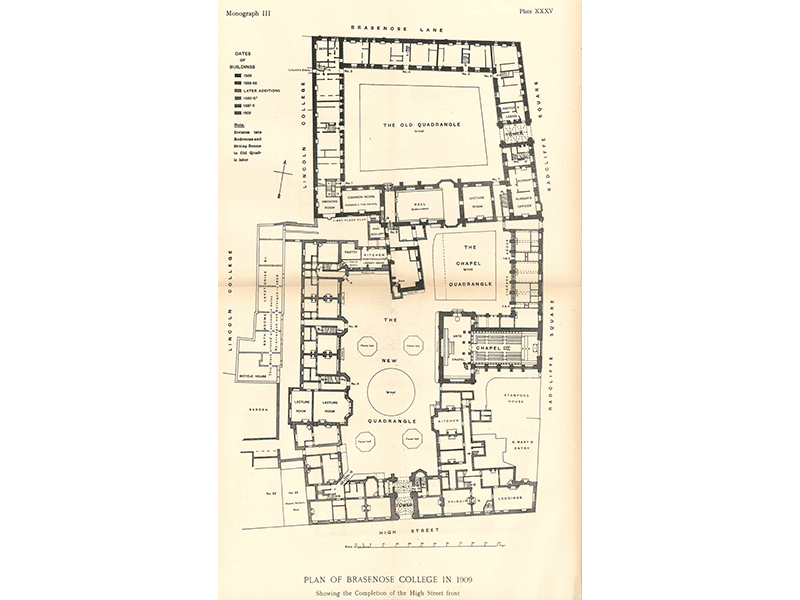
It was the late 19th century before the College finally embarked on the building of New Quad to designs by the architect Sir Thomas Graham Jackson (known for his work at Hertford College and the Oxford University Examination Schools), which took from 1880 to 1911 to complete. Most of the old buildings on the back quadrangle were demolished as part of the work, including the Principal’s House and the College brew-house.
Staircases IX-XI were built between 1880 and 1886, an extension to the kitchens with an undergraduate library above being part of the project. The High Street Tower, Staircase XIII and a new Principals’ house on the corner nearest to the University Church were constructed between 1887 and 1889 (though the Principal moved out of this and back to Old Quad in the late 1950s). Due to financial constraints the buildings were completed in three stages and the High Street front remained unfinished for twenty years. It was not until 1909-1911 that Jackson was able to complete the building he had designed thirty years before, with Broadgates, Amsterdam and Staircase XII built as part of College’s Quatercentenary celebrations.
On 7 March 1894 it was decided to build a house on the site of a shop owned by the College, which was adjacent to the Chapel. The architect of the house was Harry Wilkinson Moore, who designed many of the houses in North Oxford. The house was advertised to let as Stamford House in October 1895 and was let to a series of tenants until 1946, when it begun to be taken over for College purposes. The front of Stamford House can be viewed from Radcliffe Square/St Mary’s Passage.
Standing next to Stamford House is St Mary’s Entry. This building is most famous for its ornate door and the main structure of the house is thought to date from the 17th century. For many years it was a public house called the City Arms. The house was converted to College rooms after World War I.
During the twentieth century the numbers of students continued to rise, partly as a result of population growth and partly because higher education was no longer seen as the prerogative of the few. As more and more accommodation was needed commercial leases were terminated in favour of student use.
Staircases 14 and 15 (mostly containing rooms above shops on the High Street) were converted for College use in the early 1930s. In the 1940s Frewin Hall in New Inn Hall Street was used by students for the first time. Owned by the College since 1580, Frewin’s most famous previous occupant was Edward VII, who occupied the house as Prince of Wales when he was an undergraduate in 1859-1860.
By 1959 every staircase except one was equipped with toilets and bathrooms or showers, making it possible to demolish the old bathhouses. A small block of single study bedrooms (staircases XVI-XVIII) was built behind New Quad in 1959-1960, designed by modernist architects Powell and Moya and greatly acclaimed in its day.
Powell and Moya became well known for their modernist buildings at both Oxford and Cambridge, and in 1962 the College’s magazine, the Brazen Nose, reported ‘Powell and Moya have made a great success of a most difficult assignment: the architectural equivalent of a century in bad light on a turning wicket. On a site which had little to commend it they have produced a building with dignity and charm which is admirably adapted to the purpose it is to serve…In human terms the new building, which contains thirty-two bed-sitting-rooms, will enable every member of the College to spend two years in Brasenose (before this block was built many students lived out of College after their first year). During the 1960s a Henry Moore sculpture was loaned to the College and placed outside the building, whilst the mosaic mural on the wall by Hans Unger and Eberhard Schuize was ‘based on the polyhedron, mediaeval symbol of research and learning.’
Between the 1970s and 1990s an extension was built at Frewin. A building for graduates in St. Cross Road was completed in 1995, and a second graduate accommodation block, Hollybush Row, in 2008. In 2023, a new block of 30 ensuite student rooms was completed at Frewin. In 2025, a project to restore and redevelop the historic Frewin Hall was completed.
Adapted from articles by Elizabeth Boardman, Brasenose College Archivist 1988-2015

Throughout the years many architects have advised, submitted designs, and completed building works at Brasenose College or on estates owned by the College. These include:
In 1655 John Jackson was appointed overseer to build a new Chapel, Library and Cloisters at a salary of £1 per week.
Though it was for a long time attributed to Sir Christopher Wren, the actual design of the Chapel has been attributed to Jackson, who was also employed as master mason at St. John’s College
Submitted designs for a New Quadrangle, and demolition/rebuild of the Old Quadrangle (unbuilt).
Remodelled the interior of the Library 1779-1780.
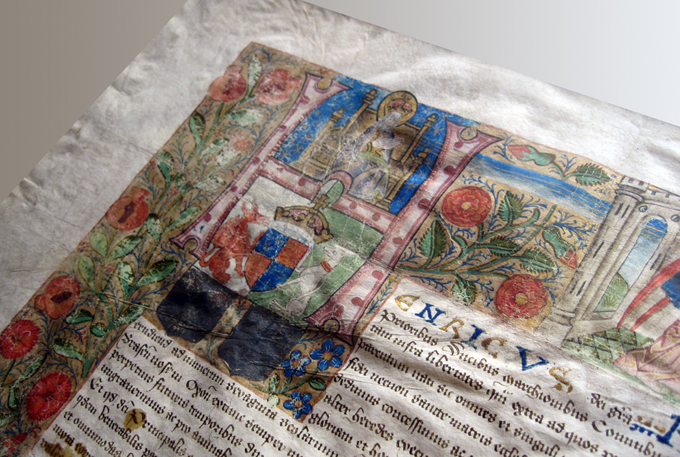
A rich historical resource documenting the life of Brasenose College and its members from its foundation in 1509 to the present day.
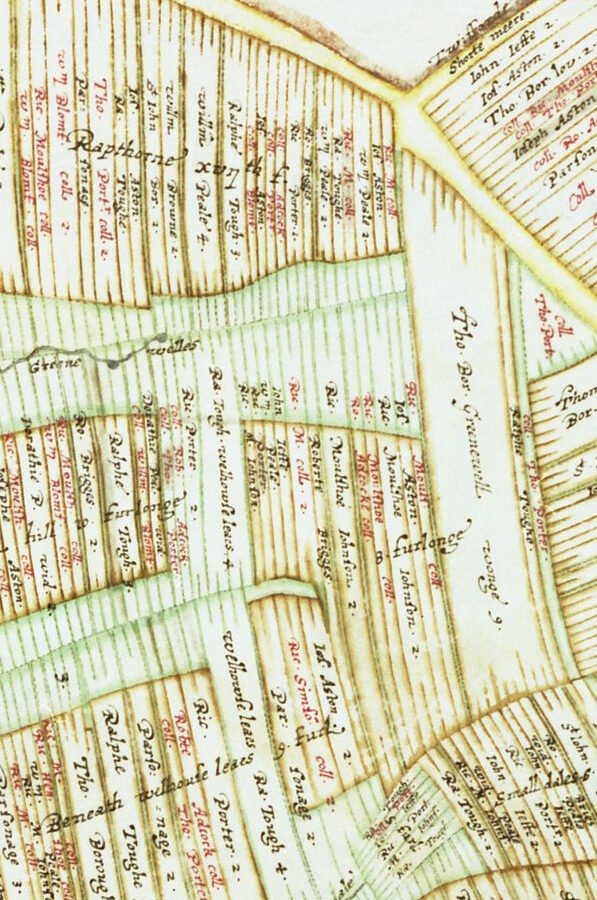
Our records trace the history of College estates from the 12th century to the present day.

Many of the archive collections are available by appointment.
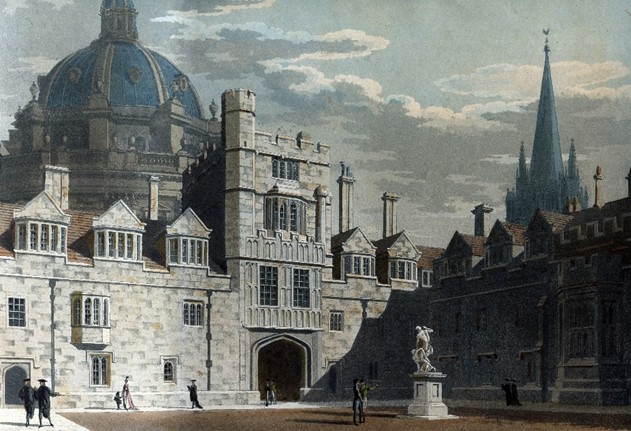
The College was founded in 1509 by Sir Richard Sutton, and William Smyth, the Bishop of Lincoln.