

In the summer of 2025 two Brasenose College Biology students spend time on Skomer Island in West Wales doing Fieldwork. Here’s their student blog on this subject:
It’s 11pm, and the day’s work is just beginning. Outside our little wooden hut on the cliff, the Manx shearwaters (henceforth “manxies”) are announcing their arrival. Their bizarre calls sound something like a cross between an excitable rooster and a wheezing old man. The colony crescendos as more and more fly in from their huge rafts in the bay, the cacophony signalling go time for us. We have 20 burrows to check tonight: some are targeted for new GPS deployments, while others are birds from which the GPS loggers now need to be retrieved, having been out collecting data for over a week. These study burrows, with names such as AF62, 609, or DB17, are imprinted like imaginary push pins onto our mental maps of the colony. We can locate each one in the pitch darkness, with the help of our red light headtorches and their reflective flag markers. Each burrow has been “sticked and flagged” in advance, with two cocktail sticks placed delicately in the entrance to allow any disturbance (such as a shearwater entering the burrow) to be easily detected. Fuelled up on Yorkshire tea and half a pack of custard creams, we begin our first round of checks. Whenever the “sticks are down!”, we feel around in the burrow for a bird, often with arms shoulder-deep in the muddy ground. If the target bird is in, we block the entrance with old towels and leave it for half an hour so that it can finish feeding the chick before being handled. Then we carefully remove the bird from the burrow and carry it down to the lab, head bundled into a bird bag to keep it calm. Miniaturised GPS devices are attached to the dorsal feathers of the shearwaters with waterproof Tesa tape. These will collect high resolution position data for the next week or two, providing valuable information on the foraging locations and other pelagic behaviours of these seabirds.
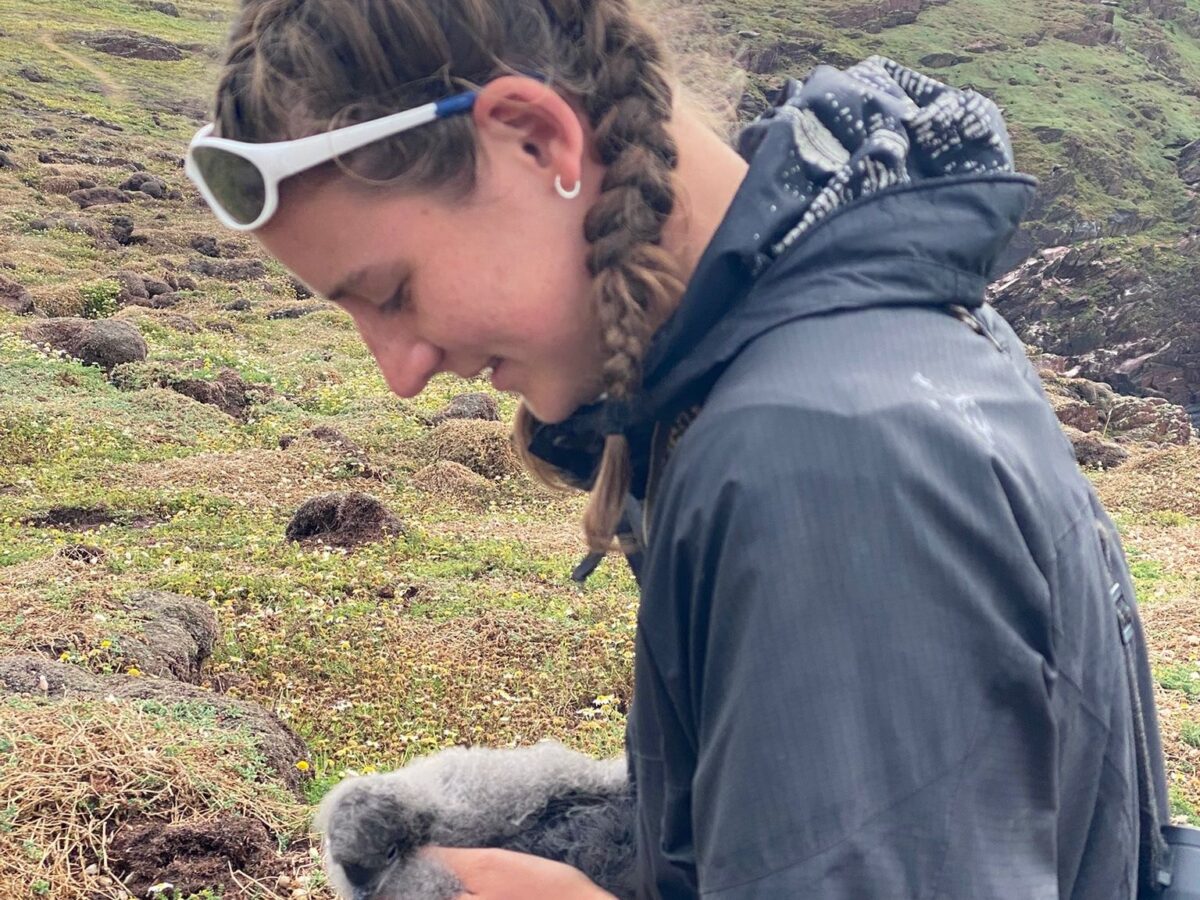
The night flies by as we busy ourselves with periodic burrow checks, and ferrying birds to and from the lab for GPS deployments. Tonight, we’re also on the lookout for prospecting immatures. These are younger birds, around 4 or 5 years old, who return to the colony to search for a burrow in preparation for future breeding attempts. They can often be identified by their behaviours: sitting around on the colony surface, poking their heads down burrows, often calling in but then scampering away when the angry occupant replies. Sometimes you’ll find a young pair preening each other on the surface, snuggled together like a couple of loved-up teenagers behind the sports hall. We observe these behaviours through infrared night-vision scopes, and pounce on the unlucky suspects to perform brood patch inspections. The brood patch of a current breeder tends to be mostly bald, just beginning to feather over again after the end of the incubation period. However, an immature brood patch is covered with grey, downy feathers known as a “grey carpet”. It’s important that we track some of these birds too, as their foraging patterns are likely to differ from breeding adults with more of a central place constraint. This information is therefore important for informing new offshore wind developments, which would ideally avoid areas that are shown to be important for pelagic seabirds from a range of age classes.
It’s very busy tonight: the surface of the colony is covered with birds. Being particularly vulnerable to daytime predators such as gulls and skuas, the shearwaters can only return to the colony under the cover of darkness. Colony activity is therefore highly correlated with light levels, determined by factors such as moon phase, cloud cover and artificial light pollution. Jiya’s project aims to investigate this relationship – in particular looking for the effects of artificial light from nearby towns along the coast, and from oil tankers moored in St Bride’s Bay. Every night she compares this variable with various metrics of colony activity: vocal activity (measured using automated Audiomoths), surface counts (determined using a thermal scope), and colony visitation (inferred from wet-dry data for a sample of breeding pairs carrying GLS immersion loggers on their leg). On darker nights like this one, the birds often don’t start leaving until around 4am, meaning another late one for us. After shedding our soaked waterproofs and scrubbing the layers of mud and guano from our hands, we end the night with a crumpet and a dram in the kitchen as we mull over our achievements. When we eventually snuggle into bed, dawn is seeping across the sky, and the gulls and oystercatchers are starting up their chorus.
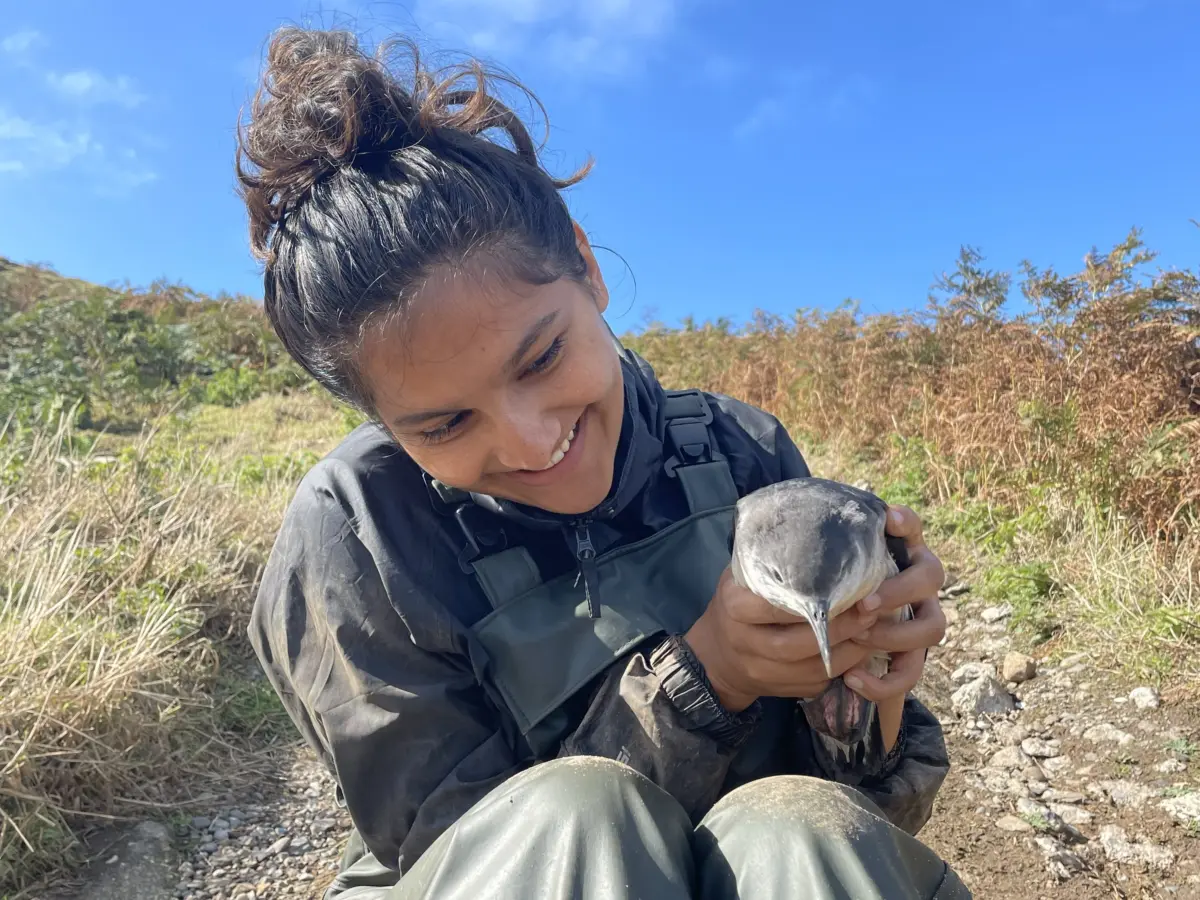
We emerge from our slumbers at around 12pm, with the heat of the day beginning to penetrate through the curtains. Having missed the arrival of 250 day-visitors on the morning boats, North Haven is once again quiet as the tourists explore the rest of the island. We eat our porridge out in the sunshine, blinking away sleep as we watch fulmars soar along the cliffs. Their chicks are just visible from tiny ledges in the cliff face; fluffy, round beanbags bearing very little resemblance to their elegant parents. The first of the grey seals are singing from their haul-outs on the beach, while the last of the puffins sit bobbing in the bay. Our daytime chores are limited: a bit of data entry, and weighing the 60 or so manxy chicks that have hatched in our long-term study burrows. Every year, these burrows are followed from when the egg is laid (around mid-May), to when the chicks fledge (around mid-September). Over this period, we monitor both the behaviours of the parent and the resulting development of the offspring. Being long-lived birds that breed for several years, parental investment decisions in one year can be important for determining breeding success in subsequent years. For example, breeding pairs may choose to neglect their egg for a few days over the incubation period (an event that the egg of this and similar species may have specifically adapted to tolerate) in order to ensure their survival and future reproduction. This is the focus of Holly’s project!Hollybird
Satisfied with our daily dose of manxy chicks, there’s plenty more seabird work to help with. Fieldworkers from the University of Gloucestershire are aiming to ring 300 lesser black-backed gull chicks, in order to estimate productivity later in the season when the fledgelings begin to gather around the edges of the island. The total number of chicks that fledged this year can then be estimated by comparing the ratio of ringed to unringed gull chicks at several sites along Skomer’s coast. For this endeavour they recruit all keen pairs of hands on the island to join the search, rummaging deep in the bracken and occasionally pursuing screeching chicks through the tangled vegetation, often dodging swooping dive-bombs from their angry parents. Brave souls will emerge victorious, covered in boggy soil and nettle stings, clutching an indignant chick that promptly excretes today’s meals out of one end, and yesterday’s meals out of the other. It will return to the bracken a few minutes later, with a neat silver bangle stamped with a unique BTO ring number around one leg.
By the time we’re done, its 5pm and last boat has carried the last of the day visitors back to the mainland. With the boats gone, we can now swim in the bay! At mid-tide, most of the rocks along the coast are covered, providing perfect seaweed gardens to explore with a mask and snorkel. Colourful wrasse flit among the fronds while drab, camouflaged blennies skit across the rocks. Diving further down, we sometimes find spider crabs hiding in the kelp forests below. Often a particularly inquisitive young seal will come to check us out too. Who needs to jet to the Bahamas?
After dinner there is time for a walk around the island, with glorious views across the sea to our neighbouring islands: Skokholm (bird observatory) in the South, Grassholm (gannet colony) in the West, and Ramsay in the North. Often the odd pod of common dolphins or harbour porpoises can be spotted foraging in the tidal races. Offshore Manx shearwaters flash their white bellies and black backs at us as they shear-soar between the waves. At dusk they begin gathering on the water, patiently waiting for darkness to fall before they return to restore the colony to its night-time hive of activity.
by Holly (formerly of Madras College, Fife) and Jiya (formerly of Townley Grammar School for Girls), 4th year MBiol students
Read more about Biology at Brasenose College.
Explore more news
-
LATEST NEWS
Open Days September 2026 - come visit!
Published 3rd September 2026
The next undergraduate Open Days at Brasenose College and the University of Oxford are taking place on Friday 18th September. We will be open from 9am to 5pm – there is no need to book!
-
LATEST NEWS
Giving Day 2026 is on it's way
Published 2nd September 2026
A new cohort of undergraduates start at Brasenose in the next few weeks with no doubt a mix of emotions. Does this take yourself back to that very first week at Brasenose? Were you excited, scared, nervous? Will you join us in commemorating those first few days in a new home by giving and supporting many more weeks at Brasenose?
-

LATEST NEWS
Brasenose College Graduation 2026
Published 4th August 2026
On the last day of July our graduating students returned to Brasenose College for a fantastic sun-soaked graduation ceremony and to celebrate all their achievements.