
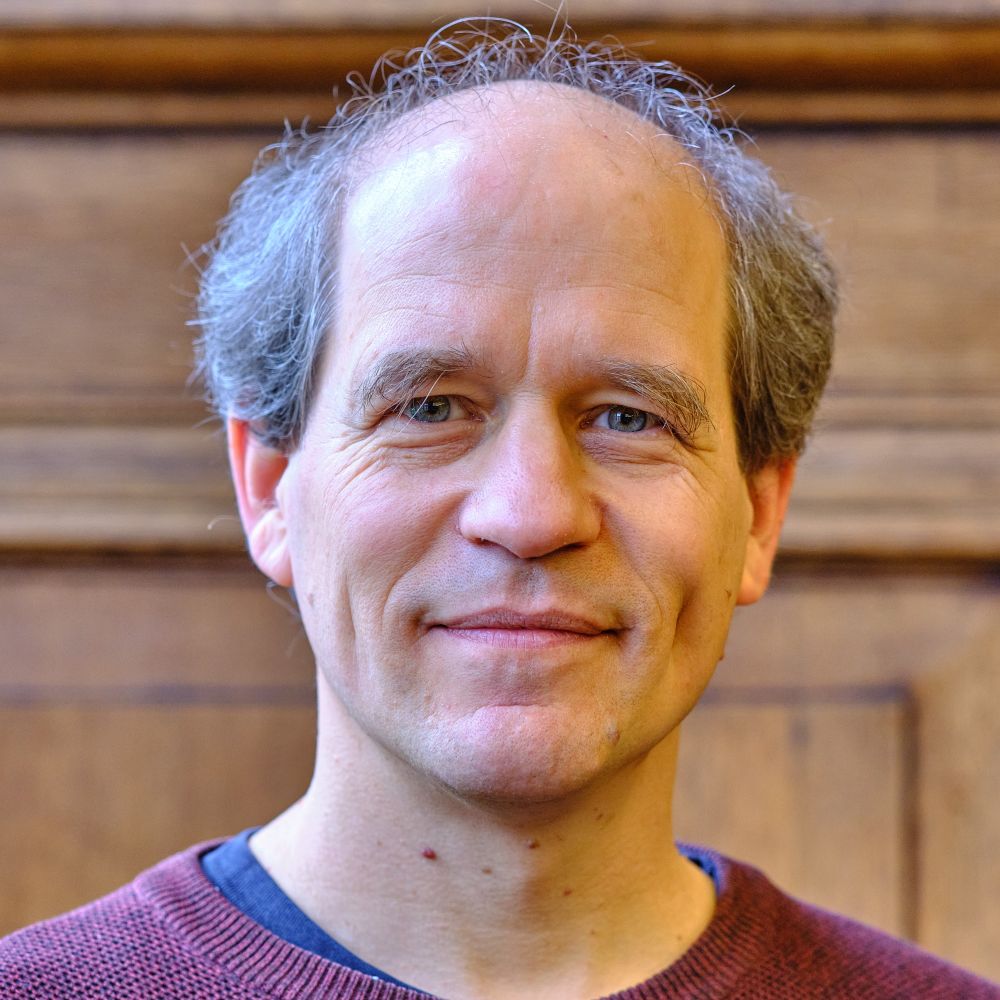
Professor Matthias Winkel
MA Oxf, PhD Paris VI
Supernumerary Fellow, Stipendiary Lecturer
After degrees in Mathematics with Computer Science and Statistics from the Universities of Münster and Manchester, I completed my doctoral degree in Probability at the University of Paris 6 (now Sorbonne Université). After a one-year pre- and post-doctoral stay in Aarhus, I moved to Oxford to join the Department of Statistics as a Departmental Lecturer in 2002, Research Lecturer since 2017, Associate Professor since 2018.
My research is in Probability at the interface with Analysis and has taken motivation from financial markets, phylogenetic data and computer science. Most recently, I have been studying stochastic models for large discrete tree structures and their continuum limits.
After tutoring for various colleges over the years, I joined Brasenose College in 2012, teaching tutorials in Probability, Statistics and Analysis, as a Supernumerary Fellow since 2019.
My college teaching covers Probability, Statistics and Analysis. I give tutorials for first and second year students in Mathematics/Mathematics and Statistics, as well as students in joint schools with Computer Science or Philosophy. As part of my appointment at the Department of Statistics, I regularly lecture on Probability and related subjects at all levels, and I also regularly contribute to the class teaching for third and fourth year students.
Over the years, my research has taken me from the study of Lévy processes via combinatorial structures such as random partitions and hierarchies to the study of discrete and continuum random trees and forests. Lévy processes are a fundamental class of stochastic processes that have classical applications in insurance mathematics and have more recently been used in the modelling of financial markets. While I have contributed to both theoretical developments and to research motivated by applications in Finance, Lévy processes feature prominently in my current research as coding functions or other building blocks of random tree structures.
The study of random trees is motivated by the study of phylogenetic trees, as well as search trees in computer science. Both tend to be large discrete structures that express or store underlying data. Large discrete structures often benefit from continuum applications, and just like the normal distribution can be used (via the central limit theorem) to approximate sums of a large number of independent discrete contributions, there are continuum approximations to many more sophisticated discrete structures. My recent and current research contributes to the development of such continuum structures in the context of discrete trees, as well as to the associated limit theory.
https://www.stats.ox.ac.uk/~winkel/indexe.html0