

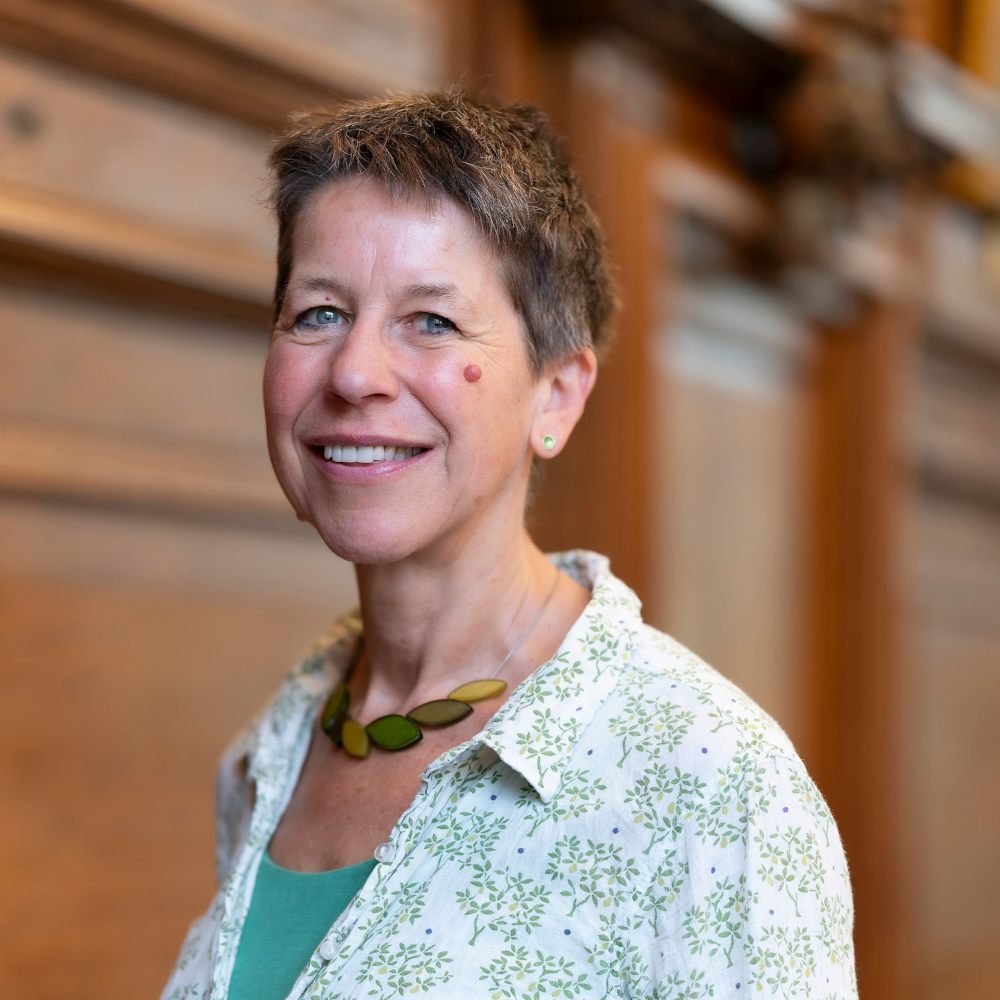
Professor Sos Eltis
BA, MPhil, DPhil
Tutorial Fellow
I came to Brasenose as a tutorial fellow in 1997 from Boston University, Massachusetts, where I was an assistant professor in the English department. Before that I did my undergraduate, Masters and doctorate at Oxford University, where I also had my first teaching jobs, lectureships at St John’s College and Christ Church. That means I’ve been in Oxford for a ridiculous number of years, so it’s a good job I love it here.
I am now a Professor of English and Theatre Studies in the English Faculty and a Tutorial Fellow in English at Brasenose College. My research centres on theatre history and drama in performance, and I have worked for decades to foster theatre studies at Oxford. It is a particular delight to see new networks and research hubs on theatre and performance opening up, together with the Cultural Programme at the Schwarzman Centre and its new state-of-the-art black box studio and performance spaces.
I teach across the broad range of literature post-1830, with a specialism in theatre from the beginning of the nineteenth century through to present day. Teaching the first-year period papers on Literature in English 1830-1910 and 1910 to present day means introducing undergraduates to wide range of texts and issues, from canonical authors such as George Eliot, Dickens, Elizabeth Gaskell, Tennyson, Oscar Wilde, T. S. Eliot, James Joyce, Virginia Woolf and Zadie Smith, through to lesser known writers such as Zora Neale Hurston, Shelagh Delaney, and Hope Mirrlees. Engaging with issues such as gender and sexuality, political agency and impact, stylistic innovation, literary values and fashions, the evolution of genres, and the possibilities of performance, students are invited to develop their own ideas and lines of approach.
I also currently co-teach a final-year option on Contemporary British and American theatre and performance with my colleague and friend Professor Kirsten Shepherd. The course encompasses a wealth of wonderful plays from Tony Kushner’s Angels in America to Branden Jacobs-Jenkins’s An Octoroon and Ella Hickson’s The Writer, looking at concepts of realism, epic form, political agency, theatrical temporality, staging the body and mind, and the cutting edge of innovation and experimentation. Past options I have taught include Oscar Wilde and the cultures of the fin de siecle, and post-war British drama and performance. I also work closely with undergraduates on their final-year dissertations, where topics have ranged widely in recent years from Oscar Wilde and concepts of hell, to death in Disney films, meta-theatricality in musical theatre, and D. H. Lawrence and orgasm, to women’s suffrage drama, and the evolution of feminist theatre.
Across the years I have supervised numerous masters and doctoral theses, including fantastic work on historiographic metatheatre, women performing Shakespeare at the fin de siecle, Feminist experiments in realism, theatrical representations of suicide, Wilkie Collins and theatrical adaptations of his novels, and the relation between professional and amateur networks in late nineteenth- and twentieth-century theatre.
I have commenced work on a new book, Rethinking Victorian Theatre, on nineteenth- and early twentieth-century performance, approaching this rich, vibrant, and exciting field from the critical perspective of recent scholarship on contemporary theatre and performance. This book is not a historical study or overview, as the majority of works on nineteenth-century theatre have tended to be, but rather an exercise in thinking with and through Victorian performance to explore the ways in which it disrupts, complicates, and confounds so many assumptions about nineteenth-century culture and society. The book will contain chapters on concepts of democracy, technology and modernity, representations of work and labour on stage, gender and sexuality, the relation between theatre and the novel, theatrical long-runs and the popular repertoire, realism and meta-theatricality, and theatres of opposition and protest. The chapter on democracy, for example, begins with the Old Price Riots of 1809, in which the audience took over Covent Garden Theatre and enacted theatrical forms of protest until seat prices were reduced and the classes desegregated. The Riots epitomised the audience’s sense of ownership over the theatre, a forum in which plots could be rewritten and endings revised by popular demand. The chapter on gender and sexuality looks at cross-dressing and cross-gender casting, not just in the thigh-slapping manner of pantomime but also in the naturalistic acting of Vesta Tilley, Marie Wilson, and Mary Keeley, exploring how the reception of their performances complicated gender binaries and produced subtle and surprising responses, critically, erotically, and theoretically. The chapter on character will consider how theatrical performance expressed identity through gesture, movement, and costume, not simply via the cliches of character types but with disconcerting fluidity of identity, blending off-stage and on-stage personae, constructing complex relations between external appearance and internal psychology. This is a book about the irrepressible, ingenious, and multifarious nature of Victorian theatre – the multivocality at the heart of the nineteenth century.
My first book, Revising Wilde: Society and Subversion in the Plays of Oscar Wilde traced Wilde’s revisions to his plays in order to challenge long-established views of the writer as a dilettante and dandy, revealing him instead as a serious philosopher and social critic who used his plays to subvert the traditional values of Victorian literature and society.
Acts of Desire: Women and Sex on Stage, 1800-1930, my second book, is a study of theatrical depictions of illicit sexuality, encompassing prostitution, adultery, bigamy and seduction. Drawing on the Lord Chamberlain’s Plays archive, correspondence on censorship, contemporary reviews, details of performance and publication, and contemporary writings on sexuality and prostitution, the book looks closely at how dramatic treatments of sexuality interacted with social and legal debates, both reflecting and influencing contemporary attitudes and anxieties.
Books:
Revising Wilde: Society and Subversion in the Plays of Oscar Wilde(Oxford University Press, 1996)
Acts of Desire: women and sex on stage, 1800-1930 (Oxford University Press, 2013)
http://ukcatalogue.oup.com/product/9780199691357.do
George Bernard Shaw, Mrs Warren’s Profession, Candida, You Never Can Tell, edited and with an introduction by Sos Eltis (Oxford University Press, Oxford World’s Classics: Oxford, 2021)
Recent Articles:
– ‘Lady Windermere’s Fan’, The Oxford Handbook of Oscar Wilde, ed. Kate Hext and Alex Murray (OUP, 2025)
– ‘Comedy’, The Cambridge Companion to Modernist Theatre, ed. Brad Kent (OUP, 2025)
– ‘“The weakest link”: suffrage writing, class interests and the isolated woman of leisure’, in The Politics of Women’s Suffrage: local, nationa,l and international dimensions, ed. Alexandra Hughes-Johnson and Lyndsey Jenkins (New Historical Perspectives, University of London Press: London. November 2021)
– ‘In the Eye of the Beholder: Decadent Theatre, New Women, and Neurotics’, in The Oxford Handbook of Decadence, ed. Jane Desmerais and David Weir (OUP: Oxford, July 2021)
– ‘Theatre and Decadence’, Decadence: A Literary History, ed. Alex Murray (Cambridge University Press: Cambridge, 2020)
– “‘It’s all symbiosis’: Peter Hall directing Beckett”, Staging Samuel Beckett in Great Britain, ed. David Tucker and Trish McTighe (Bloomsbury Methuen, forthcoming 2016)
– “Women’s Suffrage and Theatricality”, Politics, Performance and Popular Culture, ed. Kate Newey and Peter Yeandle (Manchester University Press, forthcoming 2015)
– “From Sex-war to Factory Floor: Theatrical Depictions of Women’s Work during the First World War”, British Theatre and the Great War, 1914–1919 (Palgrave, 2015)
– “The Importance of Being Earnest: performance, sincerity and self-creation”, Wilde in Earnest, ed. Emily Eells (Presses Universitaires de Paris Ouest, 2015)
– “Representing Work”, Late Victorian into Modern, 1880-1920: 21st-Century Approaches to Literature, ed. Laura Marcus, Michèle Mendelssohn and Kirsten Shepherd-Barr (OUP, 2015)
– “Performance and Identity in the Plays of Oscar Wilde”, in Oscar Wilde, ed. Jarlath Killeen (Irish Writers in their Time Series, Irish Academic Press, 2011)
– “Bringing out the acid: Noël Coward, Harold Pinter, Ivy Compton-Burnett and the uses of camp”, Modern Drama 51: 2, (Summer 2008)