

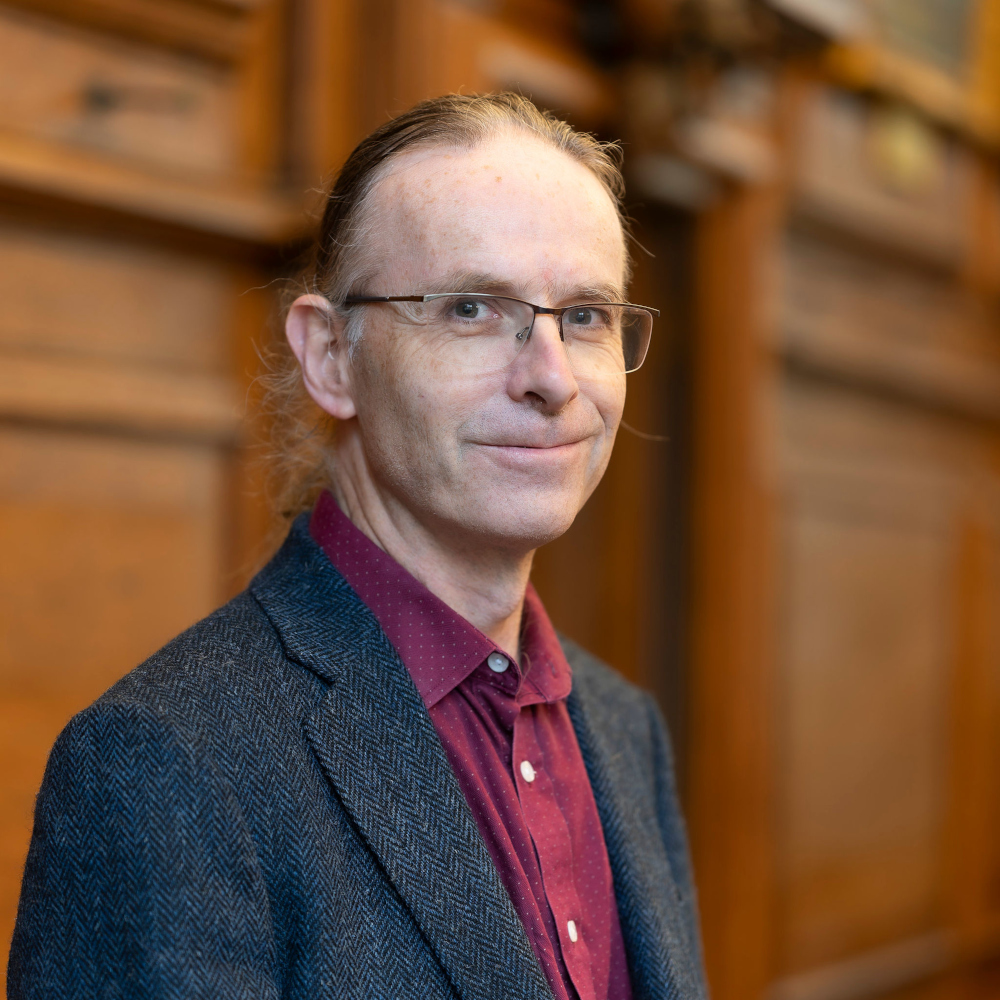
Professor Jonathan Jones
MA, DPhil
Tutorial Fellow
I grew up mostly in a small village in Worcestershire which was was one of the inspirations for the fictional village of Ambridge, but also lived for two years in Fiji and later for two years in Jordan. I came to Oxford in 1985 to study Chemistry at Corpus Christi College, and with the exception of a year spent at the University of California in Berkeley I have remained in Oxford ever since. I have worked in three university departments and have been a member of five colleges, taking up my current position as Professor of Physics and Tutorial Fellow in Physics at Brasenose in 2003. My work centres on applying nuclear magnetic resonance to problems in quantum information processing.
Within Brasenose I teach approximately one third of the undergraduate physics course throughout the first three years.
In the first year of the course I give tutorials in Classical Mechanics, including Special Relativity. For the second year this is replaced by Quantum Mechanics. In the third year I teach a compulsory course in Nuclear and Particle Physics, and an optional course in Atomic Physics, which build on the fundamental ideas I teach in the first two years.
Within the department I lecture for the fourth year option course on Quantum Information and the third year course on Laser Physics, and demonstrate in the first year Electronics teaching laboratory.
Oxford Physics provides an unusually deep and intense training in the fundamentals of physics during the first three years, and an extraordinarily wide range of topics from modern physics during the fourth year. The course is very mathematical and is sometimes described as a course in theoretical physics combined with a full practical training in the teaching laboratories. This level of intensity is made possible by the unparalleled teaching provided through the tutorial system and the general support and encouragement provided by the college system.
My research is principally concerned with the implementation of small quantum computers using nuclear magnetic resonance (NMR) techniques. I currently have a special interest in developing logic gates which are robust against systematic hardware errors, using the ideas of composite and shaped pulses developed in NMR. Previously I have worked on applications of geometric phases to robust logic, and the use of para-hydrogen to prepare pure spin states in NMR experiments.
Beyond this I have a historic interest in the development of NMR techniques to study chemical and biochemical systems, and have recently joined with colleagues in Chemistry to develop the Seedless GRAPE software package which greatly improves the sensitivity of many NMR experiments. I have also written on data analysis in psychology and the computer aided analysis of the development of legislation within the UK parliament.
https://www.physics.ox.ac.uk/research/group/nmr-quantum-computing/people
Quantum Information, Computation and Communication, J. A. Jones and D. Jaksch, Cambridge University Press (2012).
NMR: The Toolkit. How Pulse Sequences Work, P. J. Hore, J. A. Jones, and S. Wimperis, Oxford Chemistry Primers 2/e (2015).