

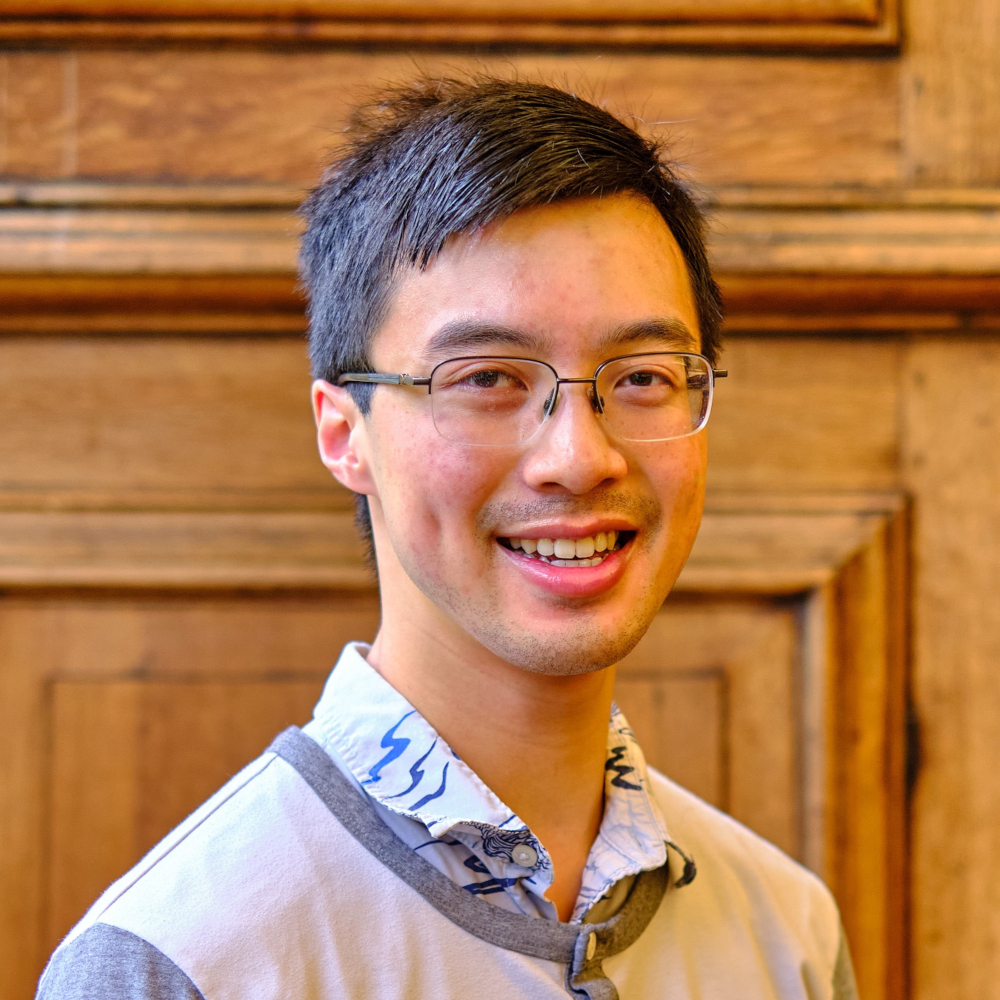
Darren Zeming Chan
BSc Waterloo
Lecturer
I joined the Oxford Laser-Plasma Accelerator Group in October 2022 as a DPhil student under the supervision of Professor Simon Hooker.
I hold a BSc in Mathematical Physics (Honours, co-operative) from the University of Waterloo, Canada. While in the co-op programme there, I had the opportunity to do research work in cold atom physics, particle physics, quantum chemistry, and quantum optics at UWaterloo, CERN (remotely), the National Research Council Canada, and the National Laboratory for AMO Physics Poland.
At Brasenose, I teach Part A Mathematical Methods for Physics. I have also previously taught Electromagnetism and Optics for both Y1s and Y2s.
I work on novel particle acceleration schemes, specifically laser wakefield acceleration (LWFA). This scheme could allow us to build future particle accelerators up to 1000 times more compact than current high-energy accelerators. In LWFA, we shoot a high-intensity laser pulse into a plasma to excite plasma waves, similar to how a duck swimming through water leaves a trailing wake behind it. Then, we carefully inject a focused electron bunch into the right phase of the wave, after which the bunch is accelerated by the strong electric fields in the plasma. This scheme can be thought of as analogous to wakesurfing.
An important thrust in our field is the development of plasma waveguides. These structures act like optical fibers to keep the drive laser pulse guided over many times its Rayleigh length, i.e. the length over which it remains focused. By keeping the pulse guided and non-diffracting, we can enhance the acceleration length and hence the energy gain. Our group has pioneered a type of plasma waveguide called the HOFI (Hydrodynamic Optical-Field Ionised) waveguide, which is free-standing, immune to laser pulse damage, and thus suitable for high-repetition rate LWFA.
I study applications of curved HOFI waveguides. An important application is for staging, whereby a curved HOFI is used to guide a fresh laser pulse into a second or subsequent LWFA stage to enhance the energy gain of the accelerator. I have demonstrated through simulations that this scheme is feasible and am working in an experiment to generate these curved HOFIs in the lab. Other applications that I’m studying include using these curved HOFIs as an off-ramp to extract depleted pulses and to induce transverse bunch oscillations for radiation generation.

https://www.physics.ox.ac.uk/our-people/chand
https://www.physics.ox.ac.uk/research/subdepartment/atomic-and-laser-physics
https://scholar.google.com/citations?user=CoTpyNUAAAAJ&hl=en
Comment on “Matter-wave interferometry with helium atoms in low-𝑙 Rydberg states”, D. Z. Chan and J. D. D. Martin, Physical Review A 109, 017301 (2024)
Near-Surface Biases in ERA5 Over the Canadian Prairies, A. K. Betts, D. Z. Chan, and R. L. Desjardins, Frontiers in Environmental Science 7, 129 (2019)